
Form Drawing

Class
1
Statement of Intent
Form drawing fosters an active inner feeling for form and helps the children to develop comprehension of the gestures of forms in their becoming. This will lead to the capacity to observe the world around them with an awareness of the inner life and qualities of that which, superficially, has a final, fixed or “dead” form; their relationship to the world becomes tangible and rich.
The children explore the language and ‘tone’ of forms through movement. Their spatial awareness and orientation are fostered through the experience of moving straight lines and curves, circle, ellipsis and lemniscate, movement and countermovement, repetition and increase.
As they learn to confidently orientate themselves in space and on the page, they are also becoming more competent in their social awareness. Moving a form like a circle as a group or whole class requires specific inner activity which Form drawing can bring about.
Experiences such as drawing a form and modelling forms in sand or on a friend’s back enhance the children’s connection with given forms.
The growing sense of form and drawing practice is preparation for learning to write. The inner relationship of the child with forms made of straight and curved lines and the ability to name and transfer those forms onto the page is directly related to an ability to correctly form letters of the alphabet.
Where possible moving the form through running, walking, hopping or skipping, drawing it in the air, on a friend’s back or in the sandpit, with chalk on the board or on the asphalt are just some of the options to be undertaken before, finally, fixing the line to the page.
“The artistic element of form drawing, in contrast to sketching, is: the line as imprint of a movement.” (Robert Kutzli, in Creative Form Drawing, 1985)
Straight Lines and Curves
This is the very first lesson of Class 1: the “imprint of a movement” (Kutzli, 1985) appears as either a straight or a curved line. The child experiences, through moving and drawing, the characteristic difference of these opposing manifestations: the unequivocal direction of the straight line demands and fosters concentration – thinking directs the will. The dynamic curved line is not directed in this way and leaves space for the individual – feeling directs the will.
Repeating Patterns
Creating repeating and sequential patterns that exhibit control over size and shape will now enhance the child's inner sense of form and balance and allow further practice of fine motor control. The use of colour adds to the harmony of the finished drawing. The class will continue to practise moving forms together, as one group or in smaller sets.
Possible Lesson Content
The Form drawing Main Lesson comes before the writing. In the interplay of straight lines and curves, in varying sizes and transformations the important forms and shapes can be developed.
-
Exercises with the vertical, the horizontal, the diagonal, angles (not explicitly discussed and analysed), star shapes, triangles, rectangles
-
Exercises with convex and concave curves, wave forms, circle, ellipsis, spirals, lemniscates etc.

Waldorf Achievement Objectives
Soul and Emotional Development:
The children will be led to an experience of
-
Finding inner balance and harmony, in body and form
-
Working with others to practice a form in movement
-
Archetypal forms in nature
Within the expected range of Class 1, the children will be able to:
-
Identify where straight and curved lines are found
-
Draw a straight line, accurately
-
Draw a curved line, accurately
-
Draw combinations of straight and curved lines, accurately
-
Describe characteristics of various forms
The Integrated Curriculum – Form Drawing in the Other Learning Areas
-
Kaupapa Māori: Forms found in Aotearoa New Zealand and Māori design, e.g., koru, simple kowhaiwahi motifs, spirals
-
English Language: Speaking; listening; writing (letters, directionality)
-
Mathematics: Geometry; number quality; number shape
-
Art: Colour, form
-
Eurythmy: Moving patterns and forms
-
Handwork: Fine-motor skills; directionality; design
-
design
Class
2
Statement of Intent
Form drawing in Class 2 continues to foster the children’s inner relationship with form and colour; their thinking is developed through this inner contemplation.
Relevant exercises support the development of positive social interaction where it is required to successfully model or move a form as a group and enable peer support for forming a shape or design.
Form drawing can further aid the development of hand-eye coordination and fine-motor development, and we encourage the children to practise rhythmical drawing to support the introduction of cursive writing.
Continuing the work begun in Class 1, the teacher can lead the children further into the world of form as well as continuing to explore forms with gross body movements before putting them on paper. Forms can be continually revisited and then extended.
Using the year's theme as story, or introducing simple stories to fit the pattern, the children will have an imaginative picture to enhance their drawing practice.
Where possible moving the form through running, walking, hopping or skipping, drawing it in the air, on a friend’s back or in the sandpit, with chalk on the board or on the asphalt are just some of the options to be undertaken before, finally, fixing the line to the page.
Possible Lesson Content
-
Exercises with curved and angular forms which are reflected on a vertical centre axis
-
Following exercises with the vertical axis, similar exercises can be done along a horizontal axis. Curved forms can be transformed into angular ones, and vice versa. This can also be extended to combination forms.
-
Exercises on the diagonal, and double symmetries
-
Dynamic running forms

Symmetry and Reflection
Symmetries and mirror forms are continued in Class 2, with increasingly complex forms introduced as the children become more skilful. The child has to become inwardly active and experience the given part as incomplete. The aim is to complete the incomplete in the imagination, and on paper.
Exercises should be completed to the best of any child’s ability, with able children being asked to take the pattern and extend it, and others being given extra opportunities to practise a certain skill until they have conquered it. Continued use of colour experimentation is encouraged, with the children reviewing the outcome of different colour combinations.
Waldorf Achievement Objectives
Soul and Emotional Development:
The children will be led to an experience of
-
Finding inner balance and harmony, in body and form
-
Working with others to practice a form in movement
-
Archetypal forms found in nature
Within the expected range of Class 2, the children will be able to:
-
Complete given symmetrical and reflected forms
-
Achieve flow and rhythm with running forms
-
Use colour accurately to enhance line and space
-
Write in a straight line across an unlined page
-
Using simple forms, create simple borders for Main Lesson books
The Integrated Curriculum – Formdrawing in the Other Learning Areas
-
Kaupapa Māori: Forms found in Aotearoa New Zealand, e.g. koru,
-
English Language: Speaking; listening; writing (letters, directionality)
-
Mathematics: Geometry; number quality; number shape
-
Art: Colour, form
-
Eurythmy: Moving patterns and forms
-
Handwork: Fine-motor skills; directionality; design


Class
3
Statement of Intent
Following the experience of axial symmetries in Class 2, the children now begin to work with corresponding symmetries, e.g., inner to outer. Expansion and contraction exercises support healthy soul development processes that are part of the nine-year-old threshold experience.
More complex forms can be constructed.
The social interaction required to successfully model or move a form as a group helps to strengthen a sense of belonging.
Form drawing lessons are important. Form drawing has the ability to focus the children, strengthen spatial awareness, ground them and support the development of hand-eye coordination. Many teachers have found that beginning a term with a week-long Main Lesson of Form drawing lays a good foundation for the rest of that term. All exercises build on previous skills and help to prepare children for both writing and mathematics work. The teacher will find many ways in which the children can experiment with, and have experience of, a form physically and spatially. Where possible moving the form through running, walking, hopping or skipping, drawing it in the air, on a friend’s back or in the sandpit, with chalk on the board or on the asphalt are just some of the options to be undertaken before, finally, fixing the line to the page.
Running and Rhythmical Forms
For the children to arrive at their own style of handwriting they must first know how to achieve the forms that make up the cursive alphabet, and this Main Lesson will allow the children the opportunity to artistically see, copy and practise forming cursive letters. As an introduction to cursive writing, emphasis is placed on regularity of size, flowing motion and correct formation of the form. Opportunities to practise and perfect each of these requirements will be given over the course of the Main Lesson.
Expansion and Contraction
Geometric and natural forms (e.g., shell, concentric waves) can be used to construct a series of drawings. The basic form grows larger, smaller or combination of both. The emphasis will always be on careful reproduction of the form, consistent in size yet with a free-flowing movement. Expansion in particular has an element of risk-taking; the task to define a space and its boundaries inwardly and then make it visible in line strengthens will and courage in a subtle manner.
Complex Forms
The children will now move through a series of increasingly complex forms; a combination of symmetry, circle, expansion and contraction will all be involved as they combine in one form many different aspects of form. For instance, a circle may hold a square and the square may hold a triangle. The children would then be asked to invert this form:
Waldorf Achievement Objectives
Soul and Emotional Development:
The children will be led to an experience of
-
Inner balance, in body and form
-
A sense of their ability to give form to space from a given foundation
-
Working with others to practice a form in movement
-
The relationship of geometric shapes to the other and the circle
Within the expected range of Class 3, the children will be able to:
-
Complete forms to achieve reflection or rotational symmetry
-
Follow a sequence of transformation
-
Achieve flow and rhythm with running forms
-
Use colour appropriately to enhance line and space
-
Form cursive letters
-
Write in a straight line across an unlined page
-
Using simple forms, create simple borders for Main Lesson books
The Integrated Curriculum – Form Drawing in the Other Learning Areas
-
Kaupapa Māori: Forms found in Aotearoa New Zealand and Māori design, e.g., koru, spirals; tukutuku panels
-
English Language: Speaking; listening; writing (cursive)
-
Mathematics: Times tables; geometry; circle divisions
-
Art: Colour, form
-
Eurythmy: Expansion and contraction; Curve of Cassini
-
Handwork: Fine-motor skills; design
Class
4
Statement of Intent
The Class 4 Form drawing lessons will focus and ground the children, while extending them at the same time.
The 'unravelling' of a complex braided form or knot imitates the soul’s current quest to unravel and understand where one's place is in the world. The crossing over their own “tracks” is an experience of the “I”, a sensing of the self.
The first freehand steps into the world of geometry will help meet the children’s growing interest in, and consciousness of, patterns and forms. It is important that, while they begin to understand the basic laws of geometry, they experience the beauty of the forms, their relationships and their names. This will let them experience something of that dimension which is beyond the practically useful and can hold answers to profound questions.
Learning through movement enhances spatial awareness and support the children’s ability to form the pattern on the page.
As time allows, continuing to work with Form drawing as an integrating, strengthening and incarnating exercise is recommended at the start of each term.
Increasingly complex patterns such as Kowhaiwhai and Celtic and Longobard braided forms and knots forms will be introduced. Symmetry and balance will be encouraged and the children should have the opportunity to experiment with transforming, transposing and metamorphosing given forms, both through movement and through drawing. Attention will be given to the repetition of a form, ensuring that the movement is one that flows freely and in which the whole body partakes.
The “over and under” of the braided forms and knots begins with physical movements and braiding as in drawing it demands sustained concentration.
Different colours may be used in the formation of the form and around it and attention may be given to the manner in which colour complements or changes the focus of a form.
The freehand construction of common geometrical forms can be introduced and practised later in this year.

Waldorf Achievement Objectives
Soul and Emotional Development:
The children will be led to an experience of
-
The importance and meaning of traditional patterns and designs in Te Ao Māori
-
Their “I”, and growing self-awareness
-
Unravelling problems
-
Tracking outcomes
-
Inner and outer balance
Within the expected range of Class 4, the children will be able to:
-
Follow a convoluted line to its beginnings
-
Accurately represent, in drawing, a woven form
-
Complete a double symmetry from a given quarter
-
Design double symmetries
-
Metamorphose forms from straight to curved/from curved to straight
-
Draw an accurate freehand circle
-
Accurately and freehand divide a circle into 12 parts
-
Identify and follow number patterns to construct a common geometric form
-
Progress within the SEANZ Learning Steps and Signposts Framework (Mathematics: Fractions; Patterns and Relationships; Position, Orientation and Transformation; Geometry)
The Integrated Curriculum – Form Drawing in the Other Learning Areas
-
Kaupapa Māori: Forms found in Aotearoa New Zealand and Māori design, e.g., koru, kowhaiwahi motifs, spirals; tukutuku panels
-
English Language: Speaking; listening; writing (cursive)
-
Mathematics: Times tables; number patterns; geometry
-
Art: Colour, form
-
Eurythmy: Woven forms; geometric forms
-
Handwork: Fine-motor skills; design; weaving (e.g., harakeke)
As time allows, continuing to work with Form drawing as an integrating, strengthening and incarnating exercise is recommended at the start of each term.
Increasingly complex patterns such as Kowhaiwhai and Celtic and Longobard braided forms and knots forms will be introduced. Symmetry and balance will be encouraged and the children should have the opportunity to experiment with transforming, transposing and metamorphosing given forms, both through movement and through drawing. Attention will be given to the repetition of a form, ensuring that the movement is one that flows freely and in which the whole body partakes.
The “over and under” of the braided forms and knots begins with physical movements and braiding as in drawing it demands sustained concentration.
Different colours may be used in the formation of the form and around it and attention may be given to the manner in which colour complements or changes the focus of a form.
The freehand construction of common geometrical forms can be introduced and practised later in this year.

Waldorf Achievement Objectives
Soul and Emotional Development:
The children will be led to an experience of
-
The importance and meaning of traditional patterns and designs in Te Ao Māori
-
Their “I”, and growing self-awareness
-
Unravelling problems
-
Tracking outcomes
-
Inner and outer balance
Within the expected range of Class 4, the children will be able to:
-
Follow a convoluted line to its beginnings
-
Accurately represent, in drawing, a woven form
-
Complete a double symmetry from a given quarter
-
Design double symmetries
-
Metamorphose forms from straight to curved/from curved to straight
-
Draw an accurate freehand circle
-
Accurately and freehand divide a circle into 12 parts
-
Identify and follow number patterns to construct a common geometric form
-
Progress within the SEANZ Learning Steps and Signposts Framework (Mathematics: Fractions; Patterns and Relationships; Position, Orientation and Transformation; Geometry)
The Integrated Curriculum – Form Drawing in the Other Learning Areas
-
Kaupapa Māori: Forms found in Aotearoa New Zealand and Māori design, e.g., koru, kowhaiwahi motifs, spirals; tukutuku panels
-
English Language: Speaking; listening; writing (cursive)
-
Mathematics: Times tables; number patterns; geometry
-
Art: Colour, form
-
Eurythmy: Woven forms; geometric forms
-
Handwork: Fine-motor skills; design; weaving (e.g., harakeke)
FORM DRAWING CURRICULUM – CLASS 5, 6 and 7
While Steiner originally gave indications for Form Drawing up to Class 5, he later suggested that Rudolf Kutzli, a teacher and founder of the first Rudolf Steiner boarding school in Switzerland, take his work further. Kutzli then made recommendations for form drawing beyond Class 5 and up to Class 12. Some of these recommendations have been included below.
Because Form Drawing focuses, grounds and extends even the older students (and adults), lessons do not need to stand alone in the timetable.
Teachers may wish to incorporate Form Drawing into the day creatively – either for morning circle or for warm up activities. Form Drawing is ‘movement’ for older children who may not want to move physically. Form Drawing could also be done before a Main Lesson – and students could speak about the previous day’s work while they do these – or before Maths or English practice lessons. Because of the grounding effect of Form Drawing, it is also a good exercise to practice a form as students return to classes from morning tea or lunch breaks to help settle them down and get them prepared for learning.
‘Form Drawing can help to enliven the creative forces needed to meet the demands of modern civilization in which we find ourselves and for which we need to prepare young people. … Form Drawing attentively adjusted to the age group develops healing life forces that will accompany the student beyond school.’
Rudolf Kutzli: Creative Form Drawing, Workbook 2, 1985
Class
5
In Class 5, form drawing reaches a point of harmony and balance that mirrors the developmental stage of the child. Often described as the “golden age” of childhood, Class 5 students are poised between the dreamy imitation of early childhood and the emerging critical thinking of adolescence. This is reflected in the symmetry, proportion and graceful precision of the forms they now work with.
Students draw increasingly complex patterns involving star forms, interlocking circles, spirals, and Celtic knotwork. These exercises develop concentration, spatial reasoning, and a sense of beauty through order and repetition.
The forms often connect to the cultural studies of the year, such as Ancient Greece and India, reflecting ideals of balance, harmony, and proportion. There may also be links to the Botany main lesson, where the spirals of plants and the geometry of leaves and flowers reveal the deep connection between nature and form. It continues to strengthen the will, refine motor skills, and cultivate a deeper sense of inner and outer harmony.

Within the expected range of Class 5, the children will be able to:
-
Draw forms from a variety of different cultures (India, Greece, etc.) - these could be done as part of a Main Lesson, as ML Book borders
-
Explore and develop a range of forms related to the botany main lesson
-
Create forms with spirals, spiral knots, spiral seals.
-
Create knot variations and forms from the Greek and Etruscan cultures
-
Draw plaited patterns and rangoli
-
Continue to explore traditional patterns and design from Te Ao Māori
These are all created freehand without using tools such as rulers, compasses, etc.
Class
6
In Class 6, form drawing evolves into a more conscious and structured exploration of form.[1] While earlier years focused on flowing, rhythmic, and symmetrical forms to support balance, coordination, and spatial awareness, Class 6 students, now entering a more intellectual and reasoning stage of development, are ready to work in a more precise and disciplined way.
Form drawing in Class 6 helps bridge the artistic approach of the younger years with the more scientific thinking that will develop further in the upper classes. It continues to nurture concentration, inner discipline, and appreciation for beauty in structure.

Within the expected range of Class 5, the children will be able to:
-
Draw freehand a range of Roman border forms
-
Use dot grids to construct forms (especially complicated rangoli and forms from the Celtic and Lombard cultures)
-
Explore and develop tapa designs as part of Pasifika ML
-
Draw freehand mandalas
-
Draw complicated variations of the lemniscate
These are all created freehand without using tools such as rulers, compasses, etc.
Class
7
In Class 7, form drawing continues to support the student's development, now deepening into more advanced geometric work. At this stage, students are experiencing the inner turmoil and questioning that often comes with adolescence. In response, form drawing offers a sense of clarity, structure, and beauty through precise geometric constructions.
They explore relationships between shapes, such as angle division, concentric circles, spirals, and complex polygons, often linked to historical or cultural contexts, like Islamic geometric art or the geometry of Renaissance architecture.
Form drawing serves both as a foundation for formal geometry lessons and as a meditative, harmonising activity. It strengthens logical thinking, perseverance, and accuracy while still honouring the aesthetic and artistic impulse. In this way, form drawing supports the adolescent's striving for meaning, balance, and personal direction
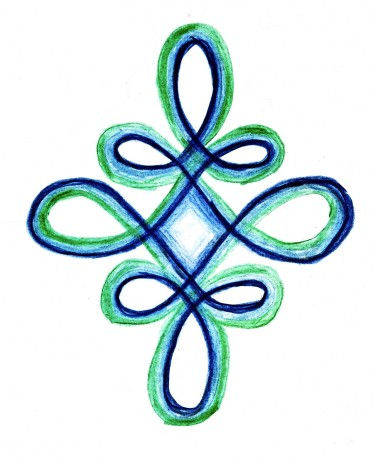
Within the expected range of Class 7, the children will be able to:
-
Demonstrate precision and care in constructing mandalas and adding colour.
-
Draw complicated knot variations
-
Explore and replicate historical or cultural geometric designs, such as Islamic tiling patterns or Renaissance constructions.
Examples of Form Drawings for Class 5 to 7 can be found in the following resources:
Giesen. Pieter: Form Drawing Workbook (date unknown) (Free PDF online)
Lord. Angela: Creative Form Drawing with children aged 10 – 12 years, Workbook 2 (2015)
Niederhauser. Hans R and Frohlich. Margaret: Form Drawing, Part II (2016)
Thaulow. Henrik: Living Lines – Form Drawing Inspiration for Steiner-Waldorf Teachers (2019)