
He Reo Puāwai

Class
1
‘Te Akomanga Tuatahi’ Class 1
Tirohanga Whānui - Overview
The Class 1 child is not yet fully aware of themselves as separate individuals, or that others are separate and unique individuals, the child relates to the world as it affects them. Their immediate response will come from their own sense of comfort or discomfort – ease or unease. The seven-year-old wishes to know that the world is beautiful, that the adults know what is right and good and will look after their needs. Children of this age can love easily and will wish to please those they love.
Whāinga Paetae - The Aim
Learning to become social, to ‘do’ with others, to experience themselves as part of a group, to take turns and to respect others needs and abilities. To look into their immediate environment and, through imaginative pictures, begin to develop a respect for, and understanding of, the world of nature. Through the imagination to make a feeling connection with the more abstract concepts that accompany our daily lives.
Pakiwaitara or Māori Fairy Tales are pre-earth history, human psychology, human development and a bridge between heaven and earth. All lessons are linked with these stories and the children are encouraged to live and learn imaginatively.
Rautaki - Strategy
Lessons could be circle based and could be shortened to half period time slots.
In the first year at school, the children absorb everything in the mood of wonder and empathy. The starting point of learning te reo Māori is choral speaking and singing waiata, based on imitation. These activities are mostly accompanied by gestures and mimicry. As soon as possible, the children should be given opportunities to speak both in smaller groups and individually. Poetic language – rhythm and rhyme, through finger games and waiata-a-ringa forms one of the two main pillars in language learning. The other pillar is prose, everyday language, which is also cultivated right from the beginning including karakia.
Language games feature prominently throughout the Lower School. While participating in these, children are totally dedicated to the actions and the accompanying language activities.
Great importance is attached to story-telling. By listening attentively, the children learn to entrust themselves to the flow of the language. Through this inner activity, they develop the ability to understand the gist of a story.
By the end of Class 1, the great majority of children have mastered what they have been engaged in, in the course of the year. This can only be achieved by thorough and frequent revision of what has been introduced and studied so that the children can continually practice anew what they have already learned.
Rudolf Steiner gave various indications about the way children could be introduced to other languages in the first three years of kura. The single most important suggestion is probably that children should encounter the language in a direct way, i.e., not through translation.
Te reo Māori should be used as much as possible to give simple daily instructions in the classroom.
Rudolf Steiner said that children as well as learning songs, stories and poems should be taught to have little conversations about everyday life.
“Poetry before Prose”
The more practical ability to communicate in te reo Māori has to be balanced by the best way for children to learn a language. Again and again, Rudolf Steiner emphasized the importance of using poetic language in the first three classes. Poetic language, based on the rhythm and rhyme, is learnt far more easily by children than is prose language.
We are lucky in Aotearoa, that within our teaching resources, we have a rich resource of waiata and waiata-ā-ringa (action songs) that have a rhythmical, lyrical and poetic language quality. Learning through waiata and waiata-ā-ringa introduces the children to the flow of te reo Māori.
The Value of Playing Games and Using ‘Formulaic Phrases’
Playing games is an important part of te reo Māori lessons in the lower school. It is widely accepted that children remember 20% of what they hear, 50% of what they hear and see, and 90% of what they experience through active participation. In an “activity-based” teaching approach, games in te reo Māori have their rightful place, and indeed are an indispensable part of lessons. They should have a special place in every Lower School language teacher’s repertoire, not just because the children like them more than other activities, but because they offer a unique way of enticing the children to speak te reo Māori. The child focuses on the action, not on the speaking or on the grouping of words and the enjoyment of active participation in a language game removes any inhibitions a particular child might have.
Rudolf Steiner recommended that, in language lessons in the Lower School, we should “cultivate the element of reflex actions by language”. So games like ‘Tahi, Rua, Tahi’ are very beneficial for the acquisition of language.
Te Reo - Language
Sometimes we are asked by parents why the writing of te reo Māori is introduced as late as Class 4. The reason for this is twofold: From a developmental perspective, the child passes through an important phase between their ninth and tenth year. They slowly begin to distance themselves from their surroundings and to perceive objects around them in a new light. So this is the right time to introduce the written mode in te reo Māori .
The other reason is to allow the children to build a large knowledge of aspects of ‘mahi toi’ in the course of the first three classes, thus having at their disposal a suitable body of language and activities that can be used in the first steps of handling the written word. The next stage, from writing to reading, is immensely facilitated when the first texts that the children get to read are somewhat familiar.
Examples of activities which could be used include:
The method of introducing the letters should be derived from principles indicated by Rudolf Steiner. Essentially the approach is one that ensures children can form a feeling connection with the sounds and letters to be introduced. A sound or phoneme is at the beginning of the process, the letter or grapheme at the end.
Stories containing the chosen object or others with the sound in question can be told to accompany the current sound/letter. However, teachers need to consider that the chosen image should be one that the children can relate to from their own experience, if a useful, authentic connection is to be formed. (Steiner, Practical Course for Teachers, Lecture 1, 1919)
Possible Activities
-
Waiata-ā-ringa (action songs)
-
Simple karakia before meals
-
Simple kōwhaiwhai patterns and spirals
-
Days of the week
-
Counting games 1-20
-
Made up stories to enhance main lessons
-
Rhymes and poems incorporating the colours.
Resource Link: Language Development
Mihimihi Introductions
What is a mihimihi?
From Te Aka Dictionary: “(noun) speech of greeting, tribute - introductory speeches at the beginning of a gathering after the more formal pōhiri. The focus of mihimihi is on the living and peaceful interrelationships. “
Mihimihi are introductions that can be used in any setting when you are introducing yourself to someone else or a group. In a school setting, these can be used at events like mihi whakatau when a new student is being welcomed to a class. Please refer to Pōwhiri document - add link
Mihimihi differ from pepeha. While anyone can introduce themselves with a mihimihi, a pepeha speaks specifically about genealogical connections. It is not related to feelings of connection, but actual genealogical connections and whakapapa.
A mihimihi can be extended to include other details beyond who you are to include details such as where you were brought up, and where you now live, and these phrases can be introduced once a student has become comfortable with the first two phrases.
Online resources:
• Hemi Kelly - Everyday Māori podcast
• Up to Speed Stacey Morrison podcast
• School journal article – link here
All children in Class 1 will be able to recite the following mihimihi to introduce themself:
Ko ……… tōku whaea. …………is my mother.
Ko ……… tōku matua. …………is my father.
Ko ……… tōku ingoa …………is my name.
Ngā Mahi Toi - The Arts
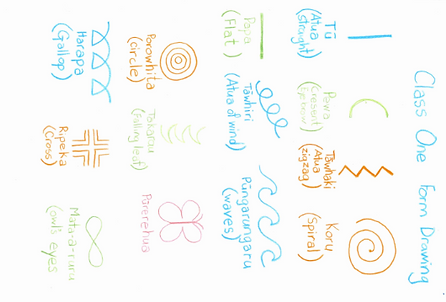
Explore the straight line and the curve in form drawing in relation to the kupu of Rongo (curve), Tū (vertical line) and Papa (horizontal line).
Simple kōwhaiwhai patterns should also be taught, including Tū Pewa, Tāwhaki, Koru, Pūngarungaru and Porowhita.
Pōkai Whenua, Pōkai Moana, - EOTC
Possible activities could include:
-
Knowing landmarks of their kura - story of significant buildings, trees and environment.
-
Experiencing the changing seasons through activities and visits.
Poutama | Learning Steps
By the end of Class 1, the children should be able to:
-
Develop relationships with simple vocabulary by using gestures and phrases.
-
Sing in unison using te reo Māori, a number of waiata
-
Participate using appropriate actions in waiata-a-ringa
-
Participate in unison in karakia
-
Participate in cultural practices such as pōwhiri, mihi whakatau
-
Respond to simple commands and basic questions
-
Count in reo from 1-10
-
Recite simple introduction mihi - their name and name of parents.
-
Use simple greetings and farewells.
-
Able to recite the following mihimihi to introduce themself:
-
Ko ……… tōku whaea. …………is my mother.
-
Ko ……… tōku matua. …………is my father.
-
Ko ……… tōku ingoa …………is my name.

Class
2
‘Te Akomanga Tuarua’ Class 2
Tirohanga Whānui - Overview
The children will be turning eight years old this year. Their development is moving towards self-identity and encompasses a growing awareness of other as different identities with their own needs and abilities. The world as it affects them is still the basis of the children’s primary social response. The eight year olds are now in the final stages of imitation; they will still be influenced by others actions however the adults must continue to be worthy role-models and set the standards for all social interactions. The will is still predominant and the healthy eight-year-old will wish to act out all experiences. The children wish to please those they love and to know that the world is a good and beautiful place. They implicitly trust that adults know what is right and good for them.
Whāinga Paetae - The Aim
To deepen awareness of their own needs and abilities and those of others. To integrate the children’s movement between heaven and earth, to allow them opportunities to heighten their understanding of themselves and others and to inspire them to look towards, and to experience a feeling for, their higher purpose. We must also continue to encourage the children’s sense for the beauty of the world, and their reverence for all life.
The first three school years have a similar character due to the nature of the child between the ages of six and nine. The contents of the first school year in te reo Māori lessons should be continued and deepened, encouraging the students to find their way into a living relationship with what they are learning.
Rautaki - Strategy
Classes could still be taught in shortened time slots and circle based. A strong element of dualism is necessary during this year (question/answer, yes/no, you/I). The children have a stronger need to communicate directly than in Class 1 .They respond best to authentic situations, such as being involved in pōwhiri, cooking, saying karakia etc. The teaching should have a strong rhythmical element in both the lesson structure and the nature of the activities, with strong contrasts between quiet activities and lively involvement. There should be a dynamic balance between being loud and quiet, speaking and listening, from experiencing reverence to experiencing humour. There also needs to be many variations around common themes (e.g. ever increasing possible answers to a given question, such as “Kei to pēhea koe?”)
Rudolf Steiner gave various indications about the way children could be introduced to other languages in the first three years of kura. The single most important suggestion is probably that children should encounter the language in a direct way, i.e., not through translation. Te reo Māori should be used as much as possible to give simple daily instructions in the classroom. Rudolf Steiner said that children as well as learning songs, stories and poems should be taught to have little conversations about everyday life.
“Poetry before Prose”
The more practical ability to communicate in te reo Māori has to be balanced by the best way for children to learn a language. Again and again, Rudolf Steiner emphasized the importance of using poetic language in the first three classes. Poetic language, based on the rhythm and rhyme, is learnt far more easily by children than is prose language.
We are lucky in Aotearoa, that within our teaching resources, we have a rich resource of waiata and waiata-ā-ringa that have a rhythmical, lyrical and poetic language quality. Learning through waiata and waiata-ā-ringa introduces the children to the flow of te reo Māori.
The Value of Playing Games and Using ‘Formulaic Phrases’
Playing games is an important part of te reo Māori lessons in the lower school. It is widely accepted that children remember 20% of what they hear, 50% of what they hear and see, and 90% of what they experience through active participation. In an “activity-based” teaching approach, games in te reo Māori have their rightful place, and indeed are an indispensable part of lessons. They should have a special place in every Lower School language teacher’s repertoire, not just because the children like them more than other activities, but because they offer a unique way of enticing the children to speak te reo Māori. The child focuses on the action, not on the speaking or on the grouping of words and the enjoyment of active participation in a language game removes any inhibitions a particular child might have.
Rudolf Steiner recommended that, in language lessons in the Lower School, we should “cultivate the element of reflex actions by language”. So games like ‘Tahi, Rua, Tahi’ are very beneficial for the acquisition of language.
Te Reo - Language
Sometimes we are asked by parents why the writing of te reo Māori is introduced as late as Class 4. The reason for this is twofold: From a developmental perspective, the child passes through an important phase between their ninth and tenth year. They slowly begin to distance themselves from their surroundings and to perceive objects around them in a new light. So this is the right time to introduce the written mode in te reo Māori .
The other reason is to allow the children to build a large knowledge of aspects of ‘mahi toi’ in the course of the first three classes, thus having at their disposal a suitable body of language and activities that can be used in the first steps of handling the written word. The next stage, from writing to reading, is immensely facilitated when the first texts that the children get to read are somewhat familiar.
Waiata and pakiwaitara that are about nature and animals should be utilized to develop the use and understanding of kupu for natural landmarks and native animals, insects and reptiles.
Examples of activities which could be used include:
-
Waiata-ā-ringa (action songs)
-
Simple karakia before meals
-
Counting games 1-20
-
Made up stories to enhance main lessons
-
Rhymes and poems incorporating the colours
-
Simple conversation games
Resource Link: Language Development
Poutama | Learning Steps
By the end of Class 2, the children should be able to:
-
Know the reo for a range of natural features ( maunga, awa, te rā, rākau)
-
Know the cardinal numbers up to 100, ordinal numbers up to 10.
-
Be able to use simple structures (e.g. “Kei hea ?” “ he aha tēnei?”)
-
Be able to understand and recognise te reo vocabulary used in telling of simple pakiwaitara
-
Be able to point out/ name different objects in the class room.
-
Know some waiata by heart.
-
Participate in action songs, including tī rakau (Maori stick game) - throwing and catching
-
Count in reo from 1-20 - both reciting the numbers and being able to recognise and count specific objects using specific phrasing. (eg “Tokohia ngā tāngata?” “E hia ngā pene?”
-
Able to recite their mihimihi to introduce themselves, extending on Class 1 by adding where they are from and their age.
-
Name a number of common living creatures of Aotearoa
Mihimihi Introductions
What is a mihimihi?
From Te Aka Dictionary: “(noun) speech of greeting, tribute - introductory speeches at the beginning of a gathering after the more formal pōhiri. The focus of mihimihi is on the living and peaceful interrelationships. “
Mihimihi are introductions that can be used in any setting when you are introducing yourself to someone else or a group. In a school setting, these can be used at events like mihi whakatau when a new student is being welcomed to a class. Please refer to Pōwhiri document - add link
Mihimihi differ from pepeha. While anyone can introduce themselves with a mihimihi, a pepeha speaks specifically about genealogical connections. It is not related to feelings of connection, but actual genealogical connections and whakapapa.
A mihimihi can be extended to include other details beyond who you are to include details such as where you were brought up, and where you now live, and these phrases can be introduced once a student has become comfortable with the first two phrases.
Online resources:
• Hemi Kelly - Everyday Māori podcast
• Up to Speed Stacey Morrison podcast
• School journal article – link here
All children in Class 2 will be able to recite the following mihimihi to introduce themselves by extending from their introductions in Class 1:
Ko ……… tōku whaea. …………is my mother.
Ko ……… tōku matua. …………is my father.
Ko ……… tōku ingoa …………is my name.
E …… āku tau I am ……. years old. Eg whitu = 7 or seven
Nō …… ahau I am from ………..
Ngā Mahi Toi - The Arts
Children are given an experience of painting and drawing pictures derived from Māori animal stories as well as simple indigenous plant forms and their seasonal moods. In form drawing simple rhythmical kōwhaiwhai patterns should be taught such as Harapa along with simple mirror images of Māori motifs.
Pōkai Whenua, Pōkai Moana - EOTC
Possible trips could include:
-
Neighbourhood visits - local park to collect acorns for counting
-
Short walks in local ngahere and achievable environments - eg Kiwi house - ngahere and manu.

Class
3
‘Te Akomanga Tuarua’ Class 3
Tirohanga Whānui - Overview
The children will turn nine in this year, and the developmental stage known as the ‘nine-year-old crisis’ occurs around this time. The children now find that they are now ‘on the earth’, there is a perception of individuality and ‘aloneness’, and they no longer experience themselves as one with the world. The children will question those things that previously went unquestioned: “Who are you to tell me?”, “What is my real name?”, “Am I adopted?” They will push boundaries, venture forth fearlessly when you wish they wouldn’t and shrivel up fearfully where once they were confident. With the ninth year there comes an important stage in the development of the growing child, and this should be carefully watched and considered when designing and teaching the Māori Curriculum. It is the age when the child first really feels separate from their surroundings, which formerly were taken for granted. Self-consciousness becomes noticeably stronger and the soul-life more inward and independent. All the child’s powers of consciousness stir to life, and a wish to learn to know both teacher and world from a new angle. The nine-year-old wants to revere consciously what was formally loved in a childlike way, but needs to feel that reverence is justified. This age makes great claims on the wisdom and tact of the teacher. The children need to be protected from a feeling of disappointment with themselves or the world, which they can so easily fall into at this age, especially in the presence of world-weary adults.
Whāinga Paetae - The Aim
The separation of Papatūānuku and Ranginui mirrors the soul feeling of the nine-year-olds who now experience themselves truly separated from the spiritual world; heaven is lost to them and who will care for them?
The pakiwaitara that tell of the creation of the heavens and the world. The great love between Papatūānuku and Ranginui and their deeds of their many children, will all enhance the student’s experience of the mystery of the world’s being.
As the children now experience their bodies as the ‘house of the soul’, Themes in te reo Māori lessons can be developed such as the connection between the body and the wharenui. This ties in with their studies on ‘House Building’. Cultivating of traditional foods such as the kūmara and hue, teaches the history of growing food and caring for the soil and the body.
Rautaki - Strategy
In their third year at school, the children’s growing understanding has to be taken into account and the children should be made more consciously aware of the use of te reo Māori. They have now a much stronger feeling for language, for nuances of both pronunciation and meaning. They require longer, more varied sentences to learn. They enjoy acting out humorous scenes and short plays that involve individual students learning roles and acting these out alone. Texts are learned that will later be written, key elements of grammar are rehearsed orally (singular and plural, persona; and possessive pronouns, articles). Recitation, karakia, waiata and kapa haka is part of every lesson.
Rudolf Steiner gave various indications about the way children could be introduced to other languages in the first three years of kura. The single most important suggestion is probably that children should encounter the language in a direct way, i.e., not through translation.
Te reo Māori should be used as much as possible to give simple daily instructions in the classroom.
Rudolf Steiner said that children as well as learning songs, stories and poems should be taught to have little conversations about everyday life.
Mihimihi Introductions
What is a mihimihi?
From Te Aka Dictionary: “(noun) speech of greeting, tribute - introductory speeches at the beginning of a gathering after the more formal pōhiri. The focus of mihimihi is on the living and peaceful interrelationships. “
Mihimihi are introductions that can be used in any setting when you are introducing yourself to someone else or a group. In a school setting, these can be used at events like mihi whakatau when a new student is being welcomed to a class. Please refer to Pōwhiri document
Mihimihi differ from pepeha. While anyone can introduce themselves with a mihimihi, a pepeha speaks specifically about genealogical connections. It is not related to feelings of connection, but actual genealogical connections and whakapapa.
A mihimihi can be extended to include other details beyond who you are to include details such as where you were brought up, and where you now live, and these phrases can be introduced once a student has become comfortable with the first two phrases.
Online resources:
• Hemi Kelly - Everyday Māori podcast
• Up to Speed Stacey Morrison podcast
• School journal article – link here
All children in Class 3 will be able to recite the following mihimihi to introduce themselves by extending from their introductions from Class 1 and 2:
Ko ……… tōku whaea. …………is my mother.
Ko ……… tōku matua. …………is my father.
Ko ……… tōku ingoa …………is my name.
E …… āku tau I am ……. years old. Eg whitu = 7 or seven
Nō …… ahau I am from …
Toko….. ngā tāngata i tōku whānau
There are ……. people in my family. Eg whā = 4 or four
“Poetry before Prose”
The more practical ability to communicate in te reo Māori has to be balanced by the best way for children to learn a language. Again and again, Rudolf Steiner emphasized the importance of using poetic language in the first three classes. Poetic language, based on the rhythm and rhyme, is learnt far more easily by children than is prose language.
We are lucky in Aotearoa, that within our teaching resources, we have a rich resource of waiata and waiata-ā-ringa that have a rhythmical, lyrical and poetic language quality. Learning through waiata and waiata-ā-ringa introduces the children to the flow of te reo Māori.
The Value of Playing Games and Using ‘Formulaic Phrases’
Playing games is an important part of te reo Māori lessons in the lower school. It is widely accepted that children remember 20% of what they hear, 50% of what they hear and see, and 90% of what they experience through active participation. In an “activity-based” teaching approach, games in te reo Māori have their rightful place, and indeed are an indispensable part of lessons. They should have a special place in every Lower School language teacher’s repertoire, not just because the children like them more than other activities, but because they offer a unique way of enticing the children to speak te reo Māori. The child focuses on the action, not on the speaking or on the grouping of words and the enjoyment of active participation in a language game removes any inhibitions a particular child might have.
Rudolf Steiner recommended that, in language lessons in the Lower School, we should “cultivate the element of reflex actions by language”. So games like ‘Tahi, Rua, Tahi’ are very beneficial for the acquisition of language.
Te Reo - Language
Sometimes we are asked by parents why the writing of te reo Māori is introduced as late as Class 4. The reason for this is twofold: From a developmental perspective, the child passes through an important phase between their ninth and tenth year. They slowly begin to distance themselves from their surroundings and to perceive objects around them in a new light. So this is the right time to introduce the written mode in te reo Māori .
The other reason is to allow the children to build a large knowledge of aspects of ‘mahi toi’ in the course of the first three classes, thus having at their disposal a suitable body of language and activities that can be used in the first steps of handling the written word. The next stage, from writing to reading, is immensely facilitated when the first texts that the children get to read are somewhat familiar.
The Class 3 Main Lesson content and story curriculum should be utilized to develop the use and understanding of kupu. Activities should include:
-
Pictorial and word association activities for furniture, shapes (tapawhā, porowhita, and tapatoru)
-
Poi rakau and poi with directions
-
Reading their timetable - times of the day (te ata, te ahi, pō etc.), clock times (hours, quarter hours, minutes)
-
Months and seasons associated with our festivals - Matariki
-
Mihimihi development (please refer Mihimihi overview below)
-
Know and use orally simple family relationships - Taina/teina, tuakana, tuahine, tungāne, matua, whaea to align with the extension of their mihimihi.
-
-
Morning circle - Use and respond orally to simple questions – Ko wai?/He aha?/E hia?
-
Games
-
Starting to introduce Takaro - seasons
-
Paper, scissors, rock
-
Pato - Snap - numbers
-
Dice games
-
Additional activities which could be taught:
-
Pictorial and word association activities and waiata for basic items of food produced on a farm, items of everyday clothing, parts of the human body and head, possessive language - taku, tōku, āku, ōku.
-
Poi rakau and poi - directions (left and right)
-
Waiata to strengthen vowel and consonant combinations and finger games
-
Modelling game (Simon says) to develop special prepositions orally and with gestures in context – Kei runga/raro/mua/muri
-
Using class readers for choral reading of te reo
-
Planning and preparing for a class based market day where students can practice asking and saying how much something costs orally in te reo - He aha te utu mō te …..(object)
Resource Link: Language Development
Learning Steps
By the end of Class 3, the children should be able to:
-
Name orally basic items of furniture
-
Name orally basic items of shapes (tapawhā, porowhita, and tapatoru)
-
Know and use orally the times of the day (te ata, te ahi, pō etc.), clock times (hours, quarter hours, minutes)
-
Know and use orally simple family relationships - Taina/teina, tuakana, tuahine, tungāne, matua, whaea to align with the extension of their mihimihi.
-
Use and respond orally to simple questions – Ko wai?/He aha?/E hia?
-
All children in Class 3 will be able to recite their mihimihi to introduce themselves by extending from their introductions from Class 1 and 2

Example of chalk work koru


Ngā Mahi Toi - The Arts
Form drawing lessons should include designs that relate to Māori creation pakiwaitara and maramataka (phases of the moon). Eg Breaking up the circle to create whetū and depict seasons.
Other possible activities could include:
-
Mirror images Eg 10c and 20c coins
-
Making gardening tools for harvesting the kūmara - using lashing Using the kumara vine/plant as inspiration for simple kōwhaiwahi patterns
-
Further development of koru design - extended spiral forms - including Rauru and Takarangi.
-
Introduce traditional design concepts that create a whare as part of house building Main Lesson.
Pōkai Whenua, Pōkai Moana - EOTC
Possible trips could include:
-
Planting of kūmara at the end of Class 2 to harvest in Class 3
-
Emphasis on mara kai.
-
Any trips which relate to harvesting and/or gathering from ngahere or awa.
-
Trips which relate to whare - house building link - embodiment of a being.
Class
4
‘‘Te Akomanga Tuawhā’ Class 4
Tirohanga Whānui - Overview
The children stand truly on the earth and they are learning to walk in its ways. Self-consciousness becomes stronger and the soul life becomes more inward. There grows a soul wish to know and love the world consciously, yet this will be tested: is it justified that I revere this occurrence; that person; this phenomena? The children must be protected from becoming disappointed, or cynical about the world, through the sharing of political standpoints, as now the faint beginnings of consequential behaviour stir to consciousness: “If I do this, then that might happen.”
Whāinga Paetae - The Aim
To lead students through learning ‘whakapapa’ and ‘Tūrangawaewae’, to discover themselves in time and place, and appreciate their world and how they arrived in it; to allow them an experience of consequences through story and to strengthen social awareness.
The pakiwaitara about ‘Māui-tikitiki-a-Taranga’ are full of adventures describing actions and consequences of these actions. The students will relate to these stories at this age.
There are also many varieties of stories available from each rohe, which will give a picture of how local geographical features were formed, and how people of the area came to be there.
Rautaki - Strategy
Rudolf Steiner gave various indications about the way children could be introduced to other languages in the first three years of kura. The single most important suggestion is probably that children should encounter the language in a direct way, i.e., not through translation.
Te reo Māori should be used as much as possible to give simple daily instructions in the classroom.
Rudolf Steiner said that children as well as learning songs, stories and poems should be taught to have little conversations about everyday life.
“Poetry before Prose”
The more practical ability to communicate in te reo Māori has to be balanced by the best way for children to learn a language. Again and again, Rudolf Steiner emphasized the importance of using poetic language in the first three classes. Poetic language, based on the rhythm and rhyme, is learnt far more easily by children than is prose language.
We are lucky in Aotearoa, that within our teaching resources, we have a rich resource of waiata and waiata-ā-ringa that have a rhythmical, lyrical and poetic language quality. Learning through waiata and waiata-ā-ringa introduces the children to the flow of te reo Māori.
The Value of Playing Games and Using ‘Formulaic Phrases’
Playing games is an important part of te reo Māori lessons in the lower school. It is widely accepted that children remember 20% of what they hear, 50% of what they hear and see, and 90% of what they experience through active participation. In an “activity-based” teaching approach, games in te reo Māori have their rightful place, and indeed are an indispensable part of lessons. They should have a special place in every Lower School language teacher’s repertoire, not just because the children like them more than other activities, but because they offer a unique way of enticing the children to speak te reo Māori. The child focuses on the action, not on the speaking or on the grouping of words and the enjoyment of active participation in a language game removes any inhibitions a particular child might have.
Rudolf Steiner recommended that, in language lessons in the Lower School, we should “cultivate the element of reflex actions by language”. So games like ‘Tahi, Rua, Tahi’ are very beneficial for the acquisition of language.
Te Reo - Language
Sometimes we are asked by parents why the writing of te reo Māori is introduced as late as Class 4. The reason for this is twofold: From a developmental perspective, the child passes through an important phase between their ninth and tenth year. They slowly begin to distance themselves from their surroundings and to perceive objects around them in a new light. So this is the right time to introduce the written mode in te reo Māori .
The other reason is to allow the children to build a large knowledge of aspects of ‘mahi toi’ in the course of the first three classes, thus having at their disposal a suitable body of language and activities that can be used in the first steps of handling the written word. The next stage, from writing to reading, is immensely facilitated when the first texts that the children get to read are somewhat familiar.
Present tense – Kei te
-
The tenses can be introduced through story and role play. The class may research aspects of their own biographies to enliven the study and bring relevance to the work. Students would examine the now moment, fleeting and ephemeral: “I am.” And finally looking ahead to that which is yet to be brings the future tense “I will”. The experience of these tenses could be explored in their study of Te reo Māori.
Suggested Teaching activities:
-
Pepeha taught through circle games and waiata, picture association activities - whiz, pop, bang, memory,
-
Waiata and stories told for local geographical place names, word finds and word searches, quiz, what/who am I game.
-
Show and tell writing activities for including adjectives, writing and telling the time
-
Using class readers for choral reading of te reo
Resource Link: Language Development
Pepeha
The following is from waitangi.org.nz website:
“Pepeha is an important and increasingly common form of introduction in Aotearoa New Zealand. While it is easy to think of it just as an introduction, Pepeha is an essential aspect of Māori culture, as it is a way of acknowledging and honouring one's connection to the land and their ancestors. The pepeha is also a way of establishing one's tūrangawaewae, a Māori concept that refers to a place where a person feels a sense of belonging, where their identity is anchored, and where they can stand and defend their rights.
Pepeha is typically used as a form of introduction and is often used at the beginning of a hui. It is also used when meeting someone for the first time or when introducing oneself in a formal or informal setting…… using it to not only introduce their name, but also acknowledging their ancestors, the land they come from, and their place in the world. It is a way of establishing a connection with the people one is meeting and creating a sense of community.
The pepeha consists of several elements, including the iwi, or tribe, the hapu, or sub-tribe, the maunga, or mountain, the awa, or river, and the marae, or meeting place. Each element of the pepeha is significant and represents an aspect of a person's connection to the land and their ancestors. In Māori culture, the land is considered sacred and is seen as a source of identity and belonging. The iwi and hapu represent a person's tribal affiliation, while the maunga and awa represent the physical features of the land that are significant to their tribal identity. The marae represents the meeting place where the person's ancestors gathered and where their cultural traditions and values are still practiced.
The use of te reo Māori, the Māori language, in the pepeha is an essential aspect of the custom. The Māori language is a taonga, or treasure,and is an integral part of Māori culture. The use of te reo Māori in the pepeha is a way of honouring and preserving the language and ensuring that it continues to be passed down to future generations.
There isn’t complete consensus on the use of pepeha for non-Māori. While some Māori advocate for its use as a way of celebrating Te Ao Māori, the Māori world which includes te reo Māori along with respect for Māori customs and protocols, others are uncomfortable with tauiwi (non-Māori) claiming mountains and rivers. Because of this, there are suggested pepeha structure that acknowledge your heritage and where you live currently, as well as ones that acknowledge the traditional landmarks but do not denote ownership.
Learning and reciting a pepeha can be a transformative experience. For those who are disconnected from their cultural roots, it can be a way of finding a sense of belonging and purpose. It can also be a way of connecting with others who share a similar cultural background. “
https://www.waitangi.org.nz/waitangi-blog/discovering-the-power-of-pepeha
Care should be taken to actively engage with all whānau around mihimihi and pepeha before starting this activity with the class to address any sensitivities around parents, guardians and caregivers. Open communication should be established with Māori whānau to determine their knowledge and connection to their pepeha before introducing this topic to a class.
Pepeha – Looking at the importance of local geographical points as a means of identifying where you come from.
All children in Class 4 will be able to recite either the following pepeha or mihimihi to introduce themselves by extending from their introductions from Classes 1,2 and 3.
The format below is for Maori students who know their pepeha.
-
Ko ………………..te maunga My mountain is ………
-
Ko ……………….. te awa My river is ………
-
Ko ………………. tōku hapū My sub-tribe is …………
-
Ko …………………tōku iwi. My tribe is………
-
Ko ………………… tōku marae My marae is ………..
-
Ko …………………. tōku waka. My waka is………
-
Ko …………….. rāua ko ………………. ōku mātua. My parents are ………
-
Ko ………………….tōku ingoa My name is ………………………………………
If you have more than one of these aspects then add ‘me’ (which means ‘and’) in between the two names e.g.“ Ko Tuki Tuki me Ngaruroro ōku awa.”
Tōku’ means my/mine and indicates one thing, whereas ōku is also my/mine but indicates a number of things/aspects. Or “ Ko Tuki Tuki me Ngaruroro ngā awa.” Te means the (1) and ngā indicates more than one aspect.
‘rāua ko’ joins two names together. When we are talking about three or more people we use ‘rātou ko’ before the second name and ‘ko’ before every other one in the list e.g. Ko Peter rātou ko Simon, ko Elizabeth ….
‘Mātua’ means both parents, and ‘Matua’ without the tohutō (macron) means father.
For information on mihimihi and the difference to pepeha please refer to Class 3.
The format below is a general extended mihimihi which is similar to a pepeha :
I tipu ake au i raro i te maru o te maunga o ……………
I grew up under the protection of the mountain of ………………..
I tipu ake au i te taha o te awa/moana o ………
I grew up beside the river/sea of ………………….
Ko (mother’s name) rāua ko (father’s name) ōku mātua
My parents are (mother’s name) and (Father’s name)
E noho ana au i …………………
I live in (suburb, town, city, region)
Ko (student’s name) tōku ingoa
My name is ………………………
Ngā Mahi Toi - The Arts
The drawing/painting of ‘kōwhaiwhai’ should be taught as a way to connect to local history, animal and plant life. Increasingly difficult patterns should be explored; especially those derived from local marae, including taniko and tukutuku patterns. Symmetry and balance will be striven for and students should have the opportunity to experiment with transforming and transposing given forms.
Pōkai Whenua, Pōkai Moana - EOTC
On all camps connect with Marae closest to the area so they can speak specifically about the whenua.
-
Studies about ‘Local Geography’ and ‘Local History’ place the students in time and space. These studies can be enhanced by visits to local geographical and historical sites that are important to tangata whenua. A noho marae at this age has a two-fold purpose; it will help the class make connections with tāngata whenua, which can be fostered and developed over subsequent years. A noho marae also provides an opportunity where the student can focus on their own whakapapa and journey of how they arrived in that place and time.
-
A noho marae also provides an opportunity to; learn the pepeha of the kura, to create a sense of connection to the rohe they reside in. This noho marae can be the first of many as they journey through the kura.
-
Whakapapa of the kura - pioneers of the kura who created the environment.
-
Sharing the identity of the kura - acknowledging current leaders/supporters.
Other possible trips could include:
-
Visit to historical sites significant for tāngata whenua.
-
Drawing kōwhaiwhai from local marae
-
Museum trip - local history
-
Ride on waka taua or waka hourua if possible to support local history and geography Main Lessons. This experience may be repeated and built upon in Class 7.
Learning Steps
By the end of Class 4, the children should be able to:
-
Recall orally Māori place names for all local towns and geographical features and the associated pakiwaitara which have been taught as part of local history/geography Main Lesson.
-
Use and respond orally to common questions – Kei te aha?/Nō hea?
-
Extend oral sentence structure to include adjectives - He pene whero tēnei.
-
be competent in tī rakau (Maori stick game) - throwing and catching
-
recite either their pepeha or mihimihi to introduce themselves by extending from their introductions from Classes 1,2 and 3.

Taniko pattern as part of Class 4 matauranga | learning programme

Examples of student koru work
Class
5
‘Te Akomanga Tuarima’ Class 5
Tirohanga Whānui - Overview
Children turning eleven years old can feel more within themselves; the heart and lung ratio of 4:1 is attained and the normally developing child has entered a stage of ‘balance’, ‘the crown of childhood’ is achieved. The students need to be led to a deeper picture of the world they live in and an experience of the ‘balance’ within themselves in the world.
Whāinga Paetae - The Aim
To help the children attain the balance of body and soul that can come at this time as they stand strongly within themselves. To encourage movement that demands strong form and rhythm and allows the students to experience full control over their bodies. This allows individuals to experience a sense of control and inner balance. This can be supported by the students learning waiata-ā-ringa, poi, kapa haka and mau rākau in a more focussed way.
Rautaki - Strategy
Children should encounter the language in a direct way, i.e., not through translation.
Te reo Māori should be used as much as possible to give simple daily instructions in the classroom.
Learning songs, stories and poems should be taught to support te reo ōpaki (informal) and te reo ōkawa (formal). Actions and games are also integral to developing language and cultural understanding and aquistion.
There should be an increasing focus on written language. Language needs to be taught in a variety of ways that support students' different learning styles.
Tapu me te Noa
In searching for this sense of balance, the student can experience that the world has many facets, many points where the microcosm and macrocosm meet and the spiritual interacts with the ordinary. This can also be experienced by the students when moving through transitions in the rhythm of the school day, the breathing in and out and at this age they can be made aware of this. The everyday practice of ‘Tapu me te Noa’ allows the students to experience this state of being.
The Value of Playing Games and Using ‘Formulaic Phrases’
Playing games is an important part of te reo Māori lessons in the lower school. It is widely accepted that children remember 20% of what they hear, 50% of what they hear and see, and 90% of what they experience through active participation. In an “activity-based” teaching approach, games in te reo Māori have their rightful place, and indeed are an indispensable part of lessons. They should have a special place in every Lower School language teacher’s repertoire, not just because the children like them more than other activities, but because they offer a unique way of enticing the children to speak te reo Māori. The child focuses on the action, not on the speaking or on the grouping of words and the enjoyment of active participation in a language game removes any inhibitions a particular child might have.
Rudolf Steiner recommended that, in language lessons in the Lower School, we should “cultivate the element of reflex actions by language”. So games like ‘Tahi, Rua, Tahi’ are very beneficial for the acquisition of language. Examples of traditional kēmu (Maori games) - ki ō rahi, ngā tapuwae, whai (string games), mū torere, koruru (knuckle bones)
Te Reo - Language
From a developmental perspective, the child has passed through an important phase. They are now able to perceive themselves as an individual in the specific time and place of the local area with a growing consciousness that they are also a citizen of Aotearoa and the Pacific. So this is the right time to consolidate/build the written mode in te reo Māori. At this age there should also be a focus on building capacity for developing written sentence structure and reading texts. This is immensely facilitated when the first texts that the children get to read are somewhat familiar, such as waiata or karakia that they know or their own work.
Examples of activities which could be used include:
-
Waiata-ā-ringa & haka
-
karakia
-
Learning Māori place names of significant geographical features of Aotearoa.
-
Extend sentence structures around Māori prepositions.
-
Significant stories from tangata whenua.
-
Possible class play based on Māori history.
-
Morning circle activities and outdoor games.
The tenses – Kei te/kua/ka
The tenses can be consolidated through story and role play. The class may research aspects of history of Aotearoa to enliven the study and bring relevance to the work. Looking back to the past involves the past tense:” I was”. Next the students would examine the now moment, fleeting and ephemeral: “I am.” And finally looking ahead to that which is yet to be brings the future tense “I will”. The experience of these tenses could be explored in their study of Te reo Māori.
Teaching and Learning activities:
-
Concepts of tapu and noa are taught in relation to following tikanga and kawa consistently. Changes of consciousness and mood as students move from one space and/or activity to another. Examples can include
-
Standing to say a verse
-
creating reverence for festivals
-
Shoes and hats off in the classroom
-
Showing reverence during karakia
-
Listening to others speak
-
Entering a space quietly
-
-
Pakiwaitara told of placenames and their origins for national geographical features.
-
Role play can be used to embed question and answer activities regarding locations – Kei hea te? (object)
-
Reciting simple karakia at the start and end of lessons and before kai should continue to be embedded into the daily rhythm of the class. In this year students should be extended beyond speaking as a whole class into speaking karakia either in small groups or individually.
-
Practice and preparation needed so the class can confidently participate in pōwhiri at Steiner Waldorf Class 5 Olympic Camp.
Pepeha
The following is from waitangi.org.nz website:
“Pepeha is an important and increasingly common form of introduction in Aotearoa New Zealand. While it is easy to think of it just as an introduction, Pepeha is an essential aspect of Māori culture, as it is a way of acknowledging and honouring one's connection to the land and their ancestors. The pepeha is also a way of establishing one's tūrangawaewae, a Māori concept that refers to a place where a person feels a sense of belonging, where their identity is anchored, and where they can stand and defend their rights.
Pepeha is typically used as a form of introduction and is often used at the beginning of a hui. It is also used when meeting someone for the first time or when introducing oneself in a formal or informal setting…… using it to not only introduce their name, but also acknowledging their ancestors, the land they come from, and their place in the world. It is a way of establishing a connection with the people one is meeting and creating a sense of community.
The pepeha consists of several elements, including the iwi, or tribe, the hapu, or sub-tribe, the maunga, or mountain, the awa, or river, and the marae, or meeting place. Each element of the pepeha is significant and represents an aspect of a person's connection to the land and their ancestors. In Māori culture, the land is considered sacred and is seen as a source of identity and belonging. The iwi and hapu represent a person's tribal affiliation, while the maunga and awa represent the physical features of the land that are significant to their tribal identity. The marae represents the meeting place where the person's ancestors gathered and where their cultural traditions and values are still practiced.
The use of te reo Māori, the Māori language, in the pepeha is an essential aspect of the custom. The Māori language is a taonga, or treasure,and is an integral part of Māori culture. The use of te reo Māori in the pepeha is a way of honouring and preserving the language and ensuring that it continues to be passed down to future generations.
There isn’t complete consensus on the use of pepeha for non-Māori. While some Māori advocate for its use as a way of celebrating Te Ao Māori, the Māori world which includes te reo Māori along with respect for Māori customs and protocols, others are uncomfortable with tauiwi (non-Māori) claiming mountains and rivers. Because of this, there are suggested pepeha structure that acknowledge your heritage and where you live currently, as well as ones that acknowledge the traditional landmarks but do not denote ownership.
Learning and reciting a pepeha can be a transformative experience. For those who are disconnected from their cultural roots, it can be a way of finding a sense of belonging and purpose. It can also be a way of connecting with others who share a similar cultural background. “
https://www.waitangi.org.nz/waitangi-blog/discovering-the-power-of-pepeha
Care should be taken to actively engage with all whānau around mihimihi and pepeha before starting this activity with the class to address any sensitivities around parents, guardians and caregivers. Open communication should be established with Māori whānau to determine their knowledge and connection to their pepeha before introducing this topic to a class.
Pepeha – Looking at the importance of local geographical points as a means of identifying where you come from.
All children in Class 5 will be able to recite either the following pepeha or mihimihi to introduce themselves by extending from their introductions from Classes 1,2, 3 and 4.
The format below is for Maori students who know their pepeha.
-
Ko ………………..te maunga My mountain is ………
-
Ko ……………….. te awa My river is ………
-
Ko ………………. tōku hapū My sub-tribe is …………
-
Ko …………………tōku iwi. My tribe is………
-
Ko ………………… tōku marae My marae is ………..
-
Ko …………………. tōku waka. My waka is………
-
Ko …………….. rāua ko ………………. ōku mātua. My parents are ………
-
Ko ……..tōku tuakana = My older sibling (of the same gender) is ………..
-
Ko ………, ko ……………… ōku tuākana = My older siblings (of the same gender) are…….. and ……….
-
Ko ……..tōku teina = My younger sibling (of the same gender) is ………..
-
Ko ………, ko ……………… ōku tēina = My younger siblings (of the same gender) are…….. and ……
-
Ko ……..tōku tungāne = My brother (of a sister who is speaking) is ………..
-
Ko ……… rāua ko ……………… ōku tungāne = My older brothers (of the sister who is speaking) are…….. and ……….
-
Ko ……..tōku tuahine = My sister (of a brother who is speaking) is ………..
-
Ko ……… rāua ko ……………… ōku tuāhine = My sisters (of a brother who is speaking) are…….. and ……….
-
Ko ………………….tōku ingoa = My name is ………………………………………
-
If there are more than two siblings of the same gender, that other siblings are talking about, use this structure. Ko ……….. ko ……………. rātou ko ……….. ōku tuākana/tēina/tungāne/tuāhine. I
-
Utilising ‘rāua ko’ to join two names only in the same sentence. For example -ko Terry rāua ko Tom ōku tungāne = My brothers are Terry and Tom.
-
Identifying when to use ‘tōku’ - My (singular), or ‘ōku’ - My plural
If you have more than one of these aspects then add ‘me’ (which means ‘and’) in between the two names e.g.“ Ko Tuki Tuki me Ngaruroro ōku awa.”
Tōku’ means my/mine and indicates one thing, whereas ōku is also my/mine but indicates a number of things/aspects. Or “ Ko Tuki Tuki me Ngaruroro ngā awa.” Te means the (1) and ngā indicates more than one aspect.
‘rāua ko’ joins two names together. When we are talking about three or more people we use ‘rātou ko’ before the second name and ‘ko’ before every other one in the list e.g. Ko Peter rātou ko Simon, ko Elizabeth ….
‘Mātua’ means both parents, and ‘Matua’ without the tohutō (macron) means father.
For information on mihimihi and the difference to pepeha please refer to Class 3.
The format below is a general extended mihimihi which is similar to a pepeha :
I tipu ake au i raro i te maru o te maunga o ……………
I grew up under the protection of the mountain of ………………..
I tipu ake au i te taha o te awa/moana o ………
I grew up beside the river/sea of ………………….
Ko (mother’s name) rāua ko (father’s name) ōku mātua
My parents are (mother’s name) and (Father’s name)
E noho ana au i …………………
I live in (suburb, town, city, region)
-
Ko ……..tōku tuakana = My older sibling (of the same gender) is ………..
-
Ko ………, ko ……………… ōku tuākana = My older siblings (of the same gender) are…….. and ……….
-
Ko ……..tōku teina = My younger sibling (of the same gender) is ………..
-
Ko ………, ko ……………… ōku tēina = My younger siblings (of the same gender) are…….. and ……
-
Ko ……..tōku tungāne = My brother (of a sister who is speaking) is ………..
-
Ko ……… rāua ko ……………… ōku tungāne = My older brothers (of the sister who is speaking) are…….. and ……….
-
Ko ……..tōku tuahine = My sister (of a brother who is speaking) is ………..
-
Ko ……… rāua ko ……………… ōku tuāhine = My sisters (of a brother who is speaking) are…….. and ……….
-
Ko ………………….tōku ingoa = My name is ………………………………………
-
If there are more than two siblings of the same gender, that other siblings are talking about, use this structure. Ko ……….. ko ……………. rātou ko ……….. ōku tuākana/tēina/tungāne/tuāhine. I
-
Utilising ‘rāua ko’ to join two names only in the same sentence. For example -ko Terry rāua ko Tom ōku tungāne = My brothers are Terry and Tom.
-
Identifying when to use ‘tōku’ - My (singular), or ‘ōku’ - My plural
Ko (student’s name) tōku ingoa
My name is ………………………
Ngā Mahi Toi - The Arts
The drawing/painting of ‘kōwhaiwhai’ should be taught as a way to connect to local history, animal and plant life. Increasingly difficult patterns may be explored; especially those derived from other rohe. Symmetry and balance will be striven for and students should have the opportunity to experiment with transforming and transposing given forms. The introduction of making pigments out of different materials from Papatūānuku as part of Botany Main Lesson.

Pōkai Whenua, Pōkai Moana - EOTC
Olympic camp - incorporate a visit to a place of historical significance in the local area where the camp is held.
Possible activities could include:
-
Attend local kapa haka festival
-
Possible museum experience to look at taonga.
-
Hīkoi around a lake or local ngahere - utilise local whenua with a local guide or expert - medicinal and edible native plants.
Learning Steps
By the end of Class 5, the children should be able to:
-
explain orally the simple origins of kōwhaiwhai patterns which relate to the Botany Main Lesson.
-
draw simple kōwhaiwhai patterns which relate to the Botany Main Lesson.
-
identify indigenous plants/trees and their uses as part of the Botany Main Lesson.
-
demonstrate origins of tangata whenua as part of Aotearoa history and geography Main Lessons.
-
recall orally Māori place names for common national placenames and geographical features and the associated pakiwaitara which have been taught.
-
use and respond orally to questions regarding locations – Kei hea te? (object)
-
recite simple karakia individually or in small groups
-
participate in traditional kēmu (Maori games) - ki ō rahi, ngā tapuwae.
-
participate in pōwhiri at Steiner Waldorf Class 5 Olympic Camp.
-
recite either their pepeha or mihimihi to introduce themselves by extending from their introductions from Classes 1-4
Class
6
‘Te Akomanga Tuaono’ Class 6
Tirohanga Whānui - Overview
The children turning twelve have arrived at the age of ‘consequences’. For the first time we can reason with them: “If you do this, then that will happen.” At this stage they can begin to practice self-control and begin to imagine into the outcomes of any deeds or behaviour. The students’ bodies are changing and, as these changes occur, they must work, albeit unconsciously, with them. They must learn to live in their bodies in a new way. The movements of these twelve-year-olds begin to lose the natural rhythm and grace of the younger child.
More than ever at this point in their development the young people must be given imaginative pictures and stories that speak to the highest aspects of their beings, they must be inspired and they must be protected from feelings of hopelessness or inadequacy.
Whāinga Paetae - The Aim
To allow the children to experience themselves as; true, honest, fair and brave.
Rautaki - Strategy
Children should encounter the language in a direct way, with as little translation as possible.
Te Reo should be used as much as possible to give simple daily instructions in the classroom. Teaching should continue to happen in morning circle but also for short periods of written work as part of an extended literacy programme along with being part of main lessons.
Learning songs, stories and poems should be taught to support te reo ōpaki (informal) and te reo ōkawa (formal). Actions and games are also integral to developing language and cultural understanding and acquisition.
There should be an increasing focus and development on written language. Language needs to be taught in a variety of ways that support students' different learning styles.
Exposure to reading and listening to contemporary Māori writers and speakers is important at this age as role models and for the perspectives that they bring.
Tapu me te Noa
In searching for this sense of balance, the student can experience that the world has many facets, many points where the microcosm and macrocosm meet and the spiritual interacts with the ordinary. This can also be experienced by the students when moving through transitions in the rhythm of the school day, the breathing in and out and at this age they can be made aware of this.
In this class students begin to look at the reasons behind differences between spaces and how we use them in alignment with a developing consciousness for why we do what do. This can include building their own rationale around tikanga.
The everyday practice of ‘Tapu me te Noa’ allows the students to experience this state of being.
Principles of Tikanga Resource
The Value of Playing Games and Using ‘Formulaic Phrases’
Playing games is an important part of te reo Māori lessons in the lower school. It is widely accepted that children remember 20% of what they hear, 50% of what they hear and see, and 90% of what they experience through active participation. In an “activity-based” teaching approach, games in te reo Māori have their rightful place, and indeed are an indispensable part of lessons. They should have a special place in every Lower School language teacher’s repertoire, not just because the children like them more than other activities, but because they offer a unique way of enticing the children to speak te reo Māori. The child focuses on the action, not on the speaking or on the grouping of words and the enjoyment of active participation in a language game removes any inhibitions a particular child might have.
Rudolf Steiner recommended that, in language lessons in the Lower School, we should “cultivate the element of reflex actions by language”. So games like ‘Tahi, Rua, Tahi’ are very beneficial for the acquisition of language.
Te Reo - Language
From a developmental perspective, the child has passed through an important phase. They are now able to perceive themselves as a citizen of Aotearoa and the Pacific. So this is the right time to consolidate the written mode in te reo Māori.
At this age it is important to maintain the written mode in te reo Māori. Revisiting sentence structures, maintaining capacity for reading texts. Unfamiliar texts can be used as their te reo vocabulary expands. Junior readers, school journals and Māori literature. Students need to be given an understanding of the common use of ‘A’ and ‘O’ possessive categories in written and oral sentences. It is important to note that there could be dialectic differences depending on the location of the kura.
Teaching and learning activities
-
A focus of the geography Main Lesson should be the connectedness of peoples, place names, journeys of individual waka and similarities of language within Te Moana-nui-a- Kiwa.
-
Reading familiar texts in te reo can be extended during this year. Students could progress from reading simple texts to more complex waiata, karakia, poetry and school journals in te reo.
Pepeha
The following is from waitangi.org.nz website:
“Pepeha is an important and increasingly common form of introduction in Aotearoa New Zealand. While it is easy to think of it just as an introduction, Pepeha is an essential aspect of Māori culture, as it is a way of acknowledging and honouring one's connection to the land and their ancestors. The pepeha is also a way of establishing one's tūrangawaewae, a Māori concept that refers to a place where a person feels a sense of belonging, where their identity is anchored, and where they can stand and defend their rights.
Pepeha is typically used as a form of introduction and is often used at the beginning of a hui. It is also used when meeting someone for the first time or when introducing oneself in a formal or informal setting…… using it to not only introduce their name, but also acknowledging their ancestors, the land they come from, and their place in the world. It is a way of establishing a connection with the people one is meeting and creating a sense of community.
The pepeha consists of several elements, including the iwi, or tribe, the hapu, or sub-tribe, the maunga, or mountain, the awa, or river, and the marae, or meeting place. Each element of the pepeha is significant and represents an aspect of a person's connection to the land and their ancestors. In Māori culture, the land is considered sacred and is seen as a source of identity and belonging. The iwi and hapu represent a person's tribal affiliation, while the maunga and awa represent the physical features of the land that are significant to their tribal identity. The marae represents the meeting place where the person's ancestors gathered and where their cultural traditions and values are still practiced.
The use of te reo Māori, the Māori language, in the pepeha is an essential aspect of the custom. The Māori language is a taonga, or treasure,and is an integral part of Māori culture. The use of te reo Māori in the pepeha is a way of honouring and preserving the language and ensuring that it continues to be passed down to future generations.
There isn’t complete consensus on the use of pepeha for non-Māori. While some Māori advocate for its use as a way of celebrating Te Ao Māori, the Māori world which includes te reo Māori along with respect for Māori customs and protocols, others are uncomfortable with tauiwi (non-Māori) claiming mountains and rivers. Because of this, there are suggested pepeha structure that acknowledge your heritage and where you live currently, as well as ones that acknowledge the traditional landmarks but do not denote ownership.
Learning and reciting a pepeha can be a transformative experience. For those who are disconnected from their cultural roots, it can be a way of finding a sense of belonging and purpose. It can also be a way of connecting with others who share a similar cultural background. “
https://www.waitangi.org.nz/waitangi-blog/discovering-the-power-of-pepeha
Care should be taken to actively engage with all whānau around mihimihi and pepeha before starting this activity with the class to address any sensitivities around parents, guardians and caregivers. Open communication should be established with Māori whānau to determine their knowledge and connection to their pepeha before introducing this topic to a class.
Pepeha – Looking at the importance of local geographical points as a means of identifying where you come from.
All children in Class 6 will be able to recite either the following pepeha or mihimihi to introduce themselves by extending from their introductions from Classes 1,2, 3 and 4.
The format below is for Maori students who know their pepeha.
-
Ko ………………..te maunga My mountain is ………
-
Ko ……………….. te awa My river is ………
-
Ko ………………. tōku hapū My sub-tribe is …………
-
Ko …………………tōku iwi. My tribe is………
-
Ko ………………… tōku marae My marae is ………..
-
Ko …………………. tōku waka. My waka is………
-
Ko …………….. rāua ko ………………. ōku mātua. My parents are ………
-
Ko ……..tōku tuakana = My older sibling (of the same gender) is ………..
-
Ko ………, ko ……………… ōku tuākana = My older siblings (of the same gender) are…….. and ……….
-
Ko ……..tōku teina = My younger sibling (of the same gender) is ………..
-
Ko ………, ko ……………… ōku tēina = My younger siblings (of the same gender) are…….. and ……
-
Ko ……..tōku tungāne = My brother (of a sister who is speaking) is ………..
-
Ko ……… rāua ko ……………… ōku tungāne = My older brothers (of the sister who is speaking) are…….. and ……….
-
Ko ……..tōku tuahine = My sister (of a brother who is speaking) is ………..
-
Ko ……… rāua ko ……………… ōku tuāhine = My sisters (of a brother who is speaking) are…….. and ……….
-
Ko ………………….tōku ingoa = My name is ………………………………………
-
If there are more than two siblings of the same gender, that other siblings are talking about, use this structure. Ko ……….. ko ……………. rātou ko ……….. ōku tuākana/tēina/tungāne/tuāhine. I
-
Utilising ‘rāua ko’ to join two names only in the same sentence. For example -ko Terry rāua ko Tom ōku tungāne = My brothers are Terry and Tom.
-
Identifying when to use ‘tōku’ - My (singular), or ‘ōku’ - My plural
-
Ko ………. tōku kuia, ko ……………… tōku koro
= My grandmother is ……………, my grandfather is …………..
-
Ko ………….. rāua ko …….. ōku kuia, ko ……….. rāua ko ……. ōku koroua
=My grandmothers are ……… and …….., my grandfathers are ……. and ……….
-
Ko ………………….tōku ingoa My name is ………………………………………
If you have more than one of these aspects then add ‘me’ (which means ‘and’) in between the two names e.g.“ Ko Tuki Tuki me Ngaruroro ōku awa.”
Tōku’ means my/mine and indicates one thing, whereas ōku is also my/mine but indicates a number of things/aspects. Or “ Ko Tuki Tuki me Ngaruroro ngā awa.” Te means the (1) and ngā indicates more than one aspect.
‘rāua ko’ joins two names together. When we are talking about three or more people we use ‘rātou ko’ before the second name and ‘ko’ before every other one in the list e.g. Ko Peter rātou ko Simon, ko Elizabeth ….
‘Mātua’ means both parents, and ‘Matua’ without the tohutō (macron) means father.
For information on mihimihi and the difference to pepeha please refer to Class 3.
The format below is a general extended mihimihi which is similar to a pepeha :
I tipu ake au i raro i te maru o te maunga o ……………
I grew up under the protection of the mountain of ………………..
I tipu ake au i te taha o te awa/moana o ………
I grew up beside the river/sea of ………………….
Ko (mother’s name) rāua ko (father’s name) ōku mātua
My parents are (mother’s name) and (Father’s name)
E noho ana au i …………………
I live in (suburb, town, city, region)
-
Ko ……..tōku tuakana = My older sibling (of the same gender) is ………..
-
Ko ………, ko ……………… ōku tuākana = My older siblings (of the same gender) are…….. and ……….
-
Ko ……..tōku teina = My younger sibling (of the same gender) is ………..
-
Ko ………, ko ……………… ōku tēina = My younger siblings (of the same gender) are…….. and ……
-
Ko ……..tōku tungāne = My brother (of a sister who is speaking) is ………..
-
Ko ……… rāua ko ……………… ōku tungāne = My older brothers (of the sister who is speaking) are…….. and ……….
-
Ko ……..tōku tuahine = My sister (of a brother who is speaking) is ………..
-
Ko ……… rāua ko ……………… ōku tuāhine = My sisters (of a brother who is speaking) are…….. and ……….
-
Ko ………………….tōku ingoa = My name is ………………………………………
-
If there are more than two siblings of the same gender, that other siblings are talking about, use this structure. Ko ……….. ko ……………. rātou ko ……….. ōku tuākana/tēina/tungāne/tuāhine. I
-
Utilising ‘rāua ko’ to join two names only in the same sentence. For example -ko Terry rāua ko Tom ōku tungāne = My brothers are Terry and Tom.
-
Identifying when to use ‘tōku’ - My (singular), or ‘ōku’ - My plural
-
Ko ………. tōku kuia, ko ……………… tōku koro
= My grandmother is ……………, my grandfather is …………..
-
Ko ………….. rāua ko …….. ōku kuia, ko ……….. rāua ko ……. ōku koroua
=My grandmothers are ……… and …….., my grandfathers are ……. and ……….
Ko (student’s name) tōku ingoa
My name is ………………………
Ngā Mahi Toi - The Arts
Students are taught and have an appreciation of kōwhaiwhai and designs of Te Moana - nui - a- Kiwa as a form of cultural literacy and as a way to reflect the natural environment. The introduction of making pigments out of different materials from Papatūānuku as part of Geology Main Lesson. Children should be extending their ability to draw kōwhaiwhai in form drawing lessons or related studies.
Possible learning activities:
-
Taiaha
-
Sāsā - Sāmoan slap dance.
-
Claywork - making of examples of taonga pūoro Eg kōauau
-
Whakairo - Carving
Pōkai Whenua, Pōkai Moana - EOTC
Local field trip to support Geology Main Lesson - connect with Marae closest to the trip location so they can speak specifically about the whenua.
Possible activities:
-
A visit to local waka hourua in relation to Te Moana - nui - a- Kiwa Main Lesson - could include a comparison of design and how this links back to place of origin.
-
Attend polynesian festival
-
Pasifika exhibitions at museums (including Maritime) and art galleries.
Vocabulary and Glossary Resource
Learning Outcomes
By the end of Class 6, the children should be able to:
-
use and respond orally to common questions – Mā wai? Nā wai? (Who will? who did?)
-
recall orally place names within Te Moana-nui-a- Kiwa and their geographical locations as part of the geography Main Lesson.
-
show understanding of the connection between the people of Moana-nui-a- Kiwa as part of the geography Main Lesson.
-
revise and recall content from previous years - EG parts of the human body and head and part of the whare.
-
recite either their pepeha or mihimihi to introduce themselves by extending from their introductions from Classes 1-5
Class 6 Project examples


Class
7
‘Te Akomanga Tuaono’ Class 7
Tirohanga Whānui - Overview
Puberty arrives and the balance is temporarily misplaced. With puberty changes can occur quickly; the ‘child’ is less in evidence physically. Students turning thirteen no longer experience themselves as children. They again ask “Who are you to tell me this?” They may resent school or having to learn te reo Māori. They would like to be independent, but do not yet have the ability to strike out on their own.
Whāinga Paetae - The Aim
To look beyond the immediate horizon and begin a voyage of discovery that mirrors the students’ own development. To present threshold pictures of bravery and sacrifice in daring to go beyond the known and to reflect on the consequences of this.
The study of biographies of Māori role models who have moved beyond their comfort zone to achieve great things will support this soul need.
The movements of the heavens are also studied from the human being’s perspective - what we can see as we stand on the earth and look upwards. The teacher can support the class by deepening the students' understanding and knowledge of Māori astronomy, phases of the moon and movement of the sun, stars and planets and how these relate to activities such as the planting of food, fishing and the navigation of Te Moana-nui-a- Kiwa, the Pacific Ocean.
Rautaki - Strategy
Children should encounter the language in a direct way, with as little translation as possible.
Te Reo should be used as much as possible to give simple daily instructions in the classroom. Teaching should continue to happen in morning circle but also for short periods of written work as part of an extended literacy programme along with being part of main lessons.
Learning songs, stories and poems should be taught to support te reo ōpaki (informal) and te reo ōkawa (formal). Actions and games are also integral to developing language and cultural understanding and acquisition.
There should be an increasing focus and development on written language. Language needs to be taught in a variety of ways that support students' different learning styles.
Exposure to reading and listening to contemporary Māori writers and speakers is important at this age as role models and for the perspectives that they bring.
Tapu me te Noa
In searching for their sense of place in the world, the student can experience that the world has many facets, many points where the spiritual interacts with the ordinary. The student needs to be supported in the beginning of their journey towards personal identity.
The rhythms of tapu me te noa provide a safe foundation from which the student can explore their interactions with the world. The everyday practice of ‘Tapu me te Noa’ allows the students to experience this state of being. In this class students can begin to take responsibility for modeling tuakana/teina relationships.
Principles of Tikanga Resource
The Value of Playing Games and Using ‘Formulaic Phrases’
Playing games is an important part of te reo Māori lessons in the lower school. It is widely accepted that children remember 20% of what they hear, 50% of what they hear and see, and 90% of what they experience through active participation. In an “activity-based” teaching approach, games in te reo Māori have their rightful place, and indeed are an indispensable part of lessons. They should have a special place in every Lower School language teacher’s repertoire, not just because the children like them more than other activities, but because they offer a unique way of enticing the children to speak te reo Māori. The child focuses on the action, not on the speaking or on the grouping of words and the enjoyment of active participation in a language game removes any inhibitions a particular child might have.
Rudolf Steiner recommended that, in language lessons in the Lower School, we should “cultivate the element of reflex actions by language”. So games like ‘Tahi, Rua, Tahi’ are very beneficial for the acquisition of language.
Te Reo - Language
At this age it is important to maintain the written mode in te reo Māori. Revisiting sentence structures, maintaining capacity for reading texts. Unfamiliar texts can be used as their te reo vocabulary expands. Junior readers, school journals and Māori literature. Students need to be given an understanding of the use of ‘A’ and ‘O’ possessive categories in written and oral sentences. It is important to note that there could be dialectic differences depending on the location of the kura.
Teaching and Learning activities:
-
Recall verbal and written descriptions of Atua and their roles, both male and female associated with voyaging and tātai arorangi, astronomy
Pepeha
The following is from waitangi.org.nz website:
“Pepeha is an important and increasingly common form of introduction in Aotearoa New Zealand. While it is easy to think of it just as an introduction, Pepeha is an essential aspect of Māori culture, as it is a way of acknowledging and honouring one's connection to the land and their ancestors. The pepeha is also a way of establishing one's tūrangawaewae, a Māori concept that refers to a place where a person feels a sense of belonging, where their identity is anchored, and where they can stand and defend their rights.
Pepeha is typically used as a form of introduction and is often used at the beginning of a hui. It is also used when meeting someone for the first time or when introducing oneself in a formal or informal setting…… using it to not only introduce their name, but also acknowledging their ancestors, the land they come from, and their place in the world. It is a way of establishing a connection with the people one is meeting and creating a sense of community.
The pepeha consists of several elements, including the iwi, or tribe, the hapu, or sub-tribe, the maunga, or mountain, the awa, or river, and the marae, or meeting place. Each element of the pepeha is significant and represents an aspect of a person's connection to the land and their ancestors. In Māori culture, the land is considered sacred and is seen as a source of identity and belonging. The iwi and hapu represent a person's tribal affiliation, while the maunga and awa represent the physical features of the land that are significant to their tribal identity. The marae represents the meeting place where the person's ancestors gathered and where their cultural traditions and values are still practiced.
The use of te reo Māori, the Māori language, in the pepeha is an essential aspect of the custom. The Māori language is a taonga, or treasure,and is an integral part of Māori culture. The use of te reo Māori in the pepeha is a way of honouring and preserving the language and ensuring that it continues to be passed down to future generations.
There isn’t complete consensus on the use of pepeha for non-Māori. While some Māori advocate for its use as a way of celebrating Te Ao Māori, the Māori world which includes te reo Māori along with respect for Māori customs and protocols, others are uncomfortable with tauiwi (non-Māori) claiming mountains and rivers. Because of this, there are suggested pepeha structure that acknowledge your heritage and where you live currently, as well as ones that acknowledge the traditional landmarks but do not denote ownership.
Learning and reciting a pepeha can be a transformative experience. For those who are disconnected from their cultural roots, it can be a way of finding a sense of belonging and purpose. It can also be a way of connecting with others who share a similar cultural background. “
https://www.waitangi.org.nz/waitangi-blog/discovering-the-power-of-pepeha
Care should be taken to actively engage with all whānau around mihimihi and pepeha before starting this activity with the class to address any sensitivities around parents, guardians and caregivers. Open communication should be established with Māori whānau to determine their knowledge and connection to their pepeha before introducing this topic to a class.
Pepeha – Looking at the importance of local geographical points as a means of identifying where you come from.
All children in Class 7 will be able to recite either the following pepeha or mihimihi to introduce themselves by extending from their introductions from Classes 1,2, 3 and 6. The focus for the year is to consolidate their prior learning.
The format below is for Maori students who know their pepeha.
-
Ko ………………..te maunga My mountain is ………
-
Ko ……………….. te awa My river is ………
-
Ko ………………. tōku hapū My sub-tribe is …………
-
Ko …………………tōku iwi. My tribe is………
-
Ko ………………… tōku marae My marae is ………..
-
Ko …………………. tōku waka. My waka is………
-
Ko …………….. rāua ko ………………. ōku mātua. My parents are ………
-
Ko ……..tōku tuakana = My older sibling (of the same gender) is ………..
-
Ko ………, ko ……………… ōku tuākana = My older siblings (of the same gender) are…….. and ……….
-
Ko ……..tōku teina = My younger sibling (of the same gender) is ………..
-
Ko ………, ko ……………… ōku tēina = My younger siblings (of the same gender) are…….. and ……
-
Ko ……..tōku tungāne = My brother (of a sister who is speaking) is ………..
-
Ko ……… rāua ko ……………… ōku tungāne = My older brothers (of the sister who is speaking) are…….. and ……….
-
Ko ……..tōku tuahine = My sister (of a brother who is speaking) is ………..
-
Ko ……… rāua ko ……………… ōku tuāhine = My sisters (of a brother who is speaking) are…….. and ……….
-
Ko ………………….tōku ingoa = My name is ………………………………………
-
If there are more than two siblings of the same gender, that other siblings are talking about, use this structure. Ko ……….. ko ……………. rātou ko ……….. ōku tuākana/tēina/tungāne/tuāhine. I
-
Utilising ‘rāua ko’ to join two names only in the same sentence. For example -ko Terry rāua ko Tom ōku tungāne = My brothers are Terry and Tom.
-
I te taha o tōku whaea, ko Sally Smith rāua ko Rangi Smith ōku tīpuna.
= On my mothers side, Sally Smith and Rangi Smith are my grandparents
-
I te taha o tōku matua, ko Sally Smith rāua ko Rangi Smith ōku tīpuna.
= On my father’s side, Sally Smith and Rangi Smith are my grandparents
-
Ko ………………….tōku ingoa My name is ………………………………………
If you have more than one of these aspects then add ‘me’ (which means ‘and’) in between the two names e.g.“ Ko Tuki Tuki me Ngaruroro ōku awa.”
Tōku’ means my/mine and indicates one thing, whereas ōku is also my/mine but indicates a number of things/aspects. Or “ Ko Tuki Tuki me Ngaruroro ngā awa.” Te means the (1) and ngā indicates more than one aspect.
‘rāua ko’ joins two names together. When we are talking about three or more people we use ‘rātou ko’ before the second name and ‘ko’ before every other one in the list e.g. Ko Peter rātou ko Simon, ko Elizabeth ….
‘Mātua’ means both parents, and ‘Matua’ without the tohutō (macron) means father.
For information on mihimihi and the difference to pepeha please refer to Class 3.
The format below is a general extended mihimihi which is similar to a pepeha :
I tipu ake au i raro i te maru o te maunga o ……………
I grew up under the protection of the mountain of ………………..
I tipu ake au i te taha o te awa/moana o ………
I grew up beside the river/sea of ………………….
Ko (mother’s name) rāua ko (father’s name) ōku mātua
My parents are (mother’s name) and (Father’s name)
E noho ana au i …………………
I live in (suburb, town, city, region)
-
Ko ……..tōku tuakana = My older sibling (of the same gender) is ………..
-
Ko ………, ko ……………… ōku tuākana = My older siblings (of the same gender) are…….. and ……….
-
Ko ……..tōku teina = My younger sibling (of the same gender) is ………..
-
Ko ………, ko ……………… ōku tēina = My younger siblings (of the same gender) are…….. and ……
-
Ko ……..tōku tungāne = My brother (of a sister who is speaking) is ………..
-
Ko ……… rāua ko ……………… ōku tungāne = My older brothers (of the sister who is speaking) are…….. and ……….
-
Ko ……..tōku tuahine = My sister (of a brother who is speaking) is ………..
-
Ko ……… rāua ko ……………… ōku tuāhine = My sisters (of a brother who is speaking) are…….. and ……….
-
Ko ………………….tōku ingoa = My name is ………………………………………
-
If there are more than two siblings of the same gender, that other siblings are talking about, use this structure. Ko ……….. ko ……………. rātou ko ……….. ōku tuākana/tēina/tungāne/tuāhine. I
-
Utilising ‘rāua ko’ to join two names only in the same sentence. For example -ko Terry rāua ko Tom ōku tungāne = My brothers are Terry and Tom.
-
I te taha o tōku whaea, ko Sally Smith rāua ko Rangi Smith ōku tīpuna.
= On my mothers side, Sally Smith and Rangi Smith are my grandparents
-
I te taha o tōku matua, ko Sally Smith rāua ko Rangi Smith ōku tīpuna.
= On my father’s side, Sally Smith and Rangi Smith are my grandparents
Ko (student’s name) tōku ingoa
My name is ………………………
Ngā Mahi Toi - The Arts
To support the development of individual identity, students should be taught a repertoire of waiata which they can confidently perform and that there is opportunity for individual leadership.
Possible learning activities:
-
Kapa haka - leadership, understanding of roles
-
Make a model of a waka hourua using traditional lashing techniques.
Pōkai Whenua, Pōkai Moana - EOTC
All camps should connect with Marae closest to the campsite area so they can speak specifically about the whenua.
Other trips which could be undertaken include visiting:
-
Opportunities to learn about Tātai Arorangi- Māori Astronomy Eg
-
Star compass - local
-
Observatory/Star dome - stories of tātai arorangi/ Māori astronomy
-
-
Maritime museum
-
Waka ama experience
-
Ride on waka hourua or waka taua as part of Explorers Main Lesson.
-
Possible odyssey/journey based in a traditional Māori area such as Whanganui River or Waikaremoana.
Vocabulary and Glossary Resource
Learning Outcomes
By the end of Class 7, the children should be able to:
-
recall and name Matariki whetu and the qualities they imbue.
-
research local significant Māori biographies and present their findings.
-
recall or describe the navigation skills and knowledge used to voyage throughout Te Moana-nui-a- Kiwa.
-
perform a repertoire of waiata.
-
recite either their pepeha or mihimihi to introduce themselves, consolidating their introductions from Classes 1-6