
History and Geography

Class
4
Statement of Intent
Having “arrived” on earth, the Class 4 child can now begin to consciously investigate their surroundings in space and time. In doing so, they create the foundations of their sense of identity as a connected individual in their whānau, community and, indeed, humanity. They are establishing their turangawaewae and their sense of belonging.
Local geography and history can be taught separately or integrated. Much of the content is interwoven. It can be taught over at least two Main Lessons.
Inā kei te mohio koe ko wai koe, i anga mai koe i hea, kei te mohio koe, kei te anga koe atu ki hea.
If you know who you are and where you are from, then you will know where you are going.
Lessons
Local Geography
The origin stories of the tangata whenua bring life to the geographical features of the rohe and lead into exploration of the local area. The aim is to get an overview from many different vantage points. The beginning of this exploration, though, is the children’s common area of interest, the school.
At first the children may be asked to draw a picturemap of the school, identifying important areas; they may then be asked to observe and then map their route to school, becoming aware of street names, landmarks and time taken on the journey. Class trips out to walk a certain route, view certain landmarks, treks up the hills to obtain as big an overview as possible all these will gradually open the children to a wider view of the immediate environment, and to a developing appreciation of different viewpoints.

While we do not seek to instruct the children in map or atlas reading in an intellectual or abstract way, we do seek to awaken their interest in the shape of the land, the contours of hills and valleys and coastline and the movement of rivers. Through stories and personal observations, the children will be given opportunities to explore the terrain and to express their knowledge in appropriate picture maps and relief maps.
Local History
From the starting point of the stories, myths and legends of the tangata whenua, the local history will be explored. Visits to historic sites and relevant museums are part of this lesson, as are stories about historic events and settlement.
A central aspect of this Main Lesson is the opportunity for the children to research their own whakapapa and family tree, to share their families' histories and to discover their roots. Sharing with their peers their family histories and the stories that brought them all together in this place at this time will deepen their understanding of each other. Inviting different generations into the classroom to share memories of things that happened when they were young will add to the depth of the study.

Waldorf Achievement Objectives
Soul and Emotional Development: The children will be led an experience of
-
The sense of connection and belonging to the place - turangawaewae
-
The sense of being part of their whānau and community, through the times – whakapapa, whanaungatanga
-
An awakening sense of identity
Within the expected range of Class 4, the children will be able to:
-
Draw a range of pictorial maps: their classroom, the school, their house/bedroom, the immediate geographical environment (widening out)
-
Describe and draw and name their route from home to school
-
Identify the major rivers, waterways, mountains and other geographical landmarks in their area
-
Name the settlements and towns in their area (Māori and English)
-
Know the compass directions, indoors and out, and read a compass
-
Present a project on their family’s whakapapa and history
-
Name the local iwi and connect local areas with their myths and legends and historical personalities

Class
5
Statement of Intent
Studying the ancient civilizations means that each child may feel a sense of 'soul satisfaction' in this survey of the ages. Emphasis is placed on the social, cultural and spiritual aspects of the civilizations' development and their time of greatest influence. The children will be given many opportunities to grow their understanding of how the achievements of the past have become the foundation of human endeavour of the present.
The history Main Lessons can be integrated with the English Main Lessons to economize available time.
Lesson
Ancient Civilizations
The children will be led into the essence of ancient civilizations such as India, Persia (Sumeria), Mesopotamia (Babylon), Egypt and Greece through stories from the sacred writings of these peoples. The area is vast, and the teacher must choose which stories the children would most benefit from, according to the constellation of the class. Some stories are particularly well suited to be told at festival times and the teacher should bear this in mind while preparing.
Legends from ancient Polynesia, China and the pre-Columbian cultures of Central and South America (Maya, Toltec, Aztec) may also be chosen.
In Class 5 history is still taught through pictorial narrative which allows the children to share and feel the deeds of historical figures. Fact-oriented, chronological presentation is best avoided at this age.
Art and design, music, poetry or verse of the relevant cultures are integrated into the history lessons as a matter of course.
Science, technology and mathematics may also be investigated where they represent foundational achievements. The Babylonian astronomy, mathematics and cuneiform writing are such achievements, as are the Egyptian irrigation systems, use of papyrus and development of writing.
The history Main Lessons in Class 5 can be very suitable contexts for individual and group research projects.
PLEASE SEE STORY CURRICULUM FOR MORE INFORMATION
Ancient India
The Ramayana and the Bhagavad-Gita are rich sources of stories about well-known and well-loved characters such as Krishna, Rama and Sita.
The class may prepare for and take part in an Indian festival such as Diwali or invite their whānau to an Indian feast.
The story of the Buddha may be told, though of a different historical time it is itself one of the essential stories of humanity
Ancient Persia
The ancient Persian culture can be studied to illustrate the development of sedentary communities, and the beginnings of farming and animal husbandry. The life of Zarathustra and texts from the Avesta and Bundahesh will bring to life the world of the Ancient Persians and their spiritual-religious context which was based on the simple tenet of “Good Thoughts, Good Words, Good Deeds”.
Mesopotamia/Babylon
Many of the achievements of the epoch of Mesopotamia have direct influence on our modern lives.
The Epic of Gilgamesh resonates with the soul-spiritual developmental stage of the Class 5 child; the advancements of building, urban environments, intensive agriculture, astronomy and mathematics, civic organisation (including recording of tax dues) and writing to record all aspects of civic life (laws, accounts, inventories etc.) resonates with their newly awakening interest in the organization and relationships of the world around them.
It is possible to design a mathematics Main Lesson (e.g., Life and Times of Number, or geometry) in the Babylonian context.
Consider also: Civilization of the Maya; Ancient China
Ancient Egypt
The students explore examples of the great achievements of Egyptian culture: the pyramids and royal graves, the development of a state system, the use of papyrus for paper and cloth, the development of writing through hieroglyphs, the sophisticated irrigation systems based on the flows of the Nile, etc.
Study of the pyramids and phenomena such as mummification will touch on the Ancient Egyptian beliefs about life after death, and reincarnation; study of the geography of the Nile Valley can include a look at how the Ancient Egyptian cosmology and world view was influenced by its characteristics.
Ancient Greece
Selected stories from Greek mythologies may be told and the children should have opportunities to read more for themselves. The interrelationship of human and god can be brought to the children’s attention and the Oracles and their role investigated. The poets, orators and philosophers may be met in selected stories and short biographies and the children should have an experience of the difference between the Spartans and the Athenians.
Pythagoras will connect with a Maths Main Lesson, the sculptures and great art works that inspired the Renaissance should be introduced, and the Greek form of drama may be investigated.
Waldorf Achievement Objectives
Soul and Emotional Development: The children will be led to
-
A developing connection with the history of the world
-
A developing understanding of cultural and religious diversity, and differences
Within the expected range of Class 5, the children will be able to:
-
Locate the ancient civilisations in time and geographically
-
Artistically represent selected motifs and scenes from the ancient civilisations in the relevant style
-
Discuss aspects of cultural characteristics and technological achievements in given civilisations (a variety of responses is possible)
Statement of Intent
Having connected with their local environment in Class 4, the children now expand their consciousness to Aotearoa New Zealand.
Main Lesson
Aotearoa New Zealand
Following on from the Local Geography and Local History Main Lessons of Class 4, the children will now study the geographical features of the whole country.
The point of departure for this lesson is the perspective of the tangata whenua, as illustrated, for example, through the story of how Maui fished up Te Ika-a-Māui.
Creation myths and stories of historical events related to geographical features will be told throughout the lesson.
Learning initially in an imaginative-artistic way children become familiar with the outline and geographical features and place names of the whole of Aotearoa. It is through stories of historical episodes that the configuration of the land (maunga, awa, national parks, towns and cities) can be investigated.
The children will learn about the topography of Aotearoa New Zealand and its diversity. The Southern Alps / Kā Tiritiri o te Moana and the Central Plateau can be contrasted; the fertile plains in the north can be compared with the plains of Te Wai Pounamu that are traversed by braided rivers. The temperate rainforests and the path and direction of the major rivers can be investigated.
The children will become familiar with major topographical features such as the mountain ranges that bisect both islands, the big lakes, regions, towns and cities.
The children will investigate why settlements are located where they are. Core early settler industries can be explored (whalers, gold diggers, gum diggers, etc). and the tangata whenua role in these.

Waldorf Achievement Objectives
Soul and Emotional Development: The children will be led towards
-
An appreciation of the diversity and aesthetics of the land they live in
-
A growing understanding that different peoples have different relationships to the land
-
A growing awareness that natural spaces are changed by human economic and cultural activity, and the social and ecological responsibilities that arise from this
Within the expected range of Class 5, the children will be able to:
-
Discuss the importance of major geographical features to Māori
-
Locate major geographical features, towns and cities on a map
-
Discuss the reasons for settlements

Class
6
Statement of Intent
Class 6 is a time when the children experience the transformation of their bone and muscular structures, and their awakening logical faculties which are at first given to black-and-white judgements. The history lessons accompany this development by placing before them perceptions of the particular dualities and foundational structures that were exemplified in the Roman Empire.
An investigation of the development and inter-relatedness of the three monotheistic religions Judaism, Christianity and Islam in the time of the Middle Ages can help to build a foundation for tolerance and acceptance. A brief study of the history of Islam, will add an important perspective to this epoch. The children will learn about how the meeting of east and west in the “Holy Land” facilitated new thinking and experiences in western culture and contributed to the end of the “dark ages” in Europe. This understanding, too, is an important foundation for openness and tolerance. For the Class 6 child it is another counterpoint to their developmental tendency to say “either…or”, with little grey area in between.
Instilling encyclopaedic knowledge of history is not the point in these lessons. While the children will continue to take hold of world history’s time and space organisation in various ways, they should experience these epochs through descriptions of the lives of charismatic as well as ordinary people, of events of universal importance and of ordinary, daily life.
The history Main Lessons can be integrated with the English lessons to economize available time.
Lessons
The Founding of Rome
This first Main Lesson surveys the period from the founding of Rome by Romulus and Remus through to the expulsion of the last king and the founding of the Republic. The story begins veiled in mythology, progresses to the ideal stage of community, the diverse character of the kings and their contributions to the success (or not) of their growing community and arrives, with the fall of the last king, at the dawn of the Republic.

The Roman Republic
The children will continue to trace the history of the Republic and the rise and fall of the Empire. Through selected stories they can experience the valour and heroism of the Romans who placed their own need second to those of the Republic. They can also experience the decline that began to occur when people in power lost sight of that virtue.
The children encounter governance structures, the rise and fall of personalities in power and the tension between the ever-strengthening materialism of this civilization and the belief in pantheon of gods. These relationships are presented through stories rather than discussed explicitly.
The lives of ordinary Romans within the civic and military structures of the Republic are endlessly fascinating for children of this age.
The history of the governance of Rome will further develop the children's understanding of our own system of democracy. They can immerse themselves in this idea by, for example, creating a set of class laws and a basic tribunal system.
Possible Lesson Content
-
Writing: e.g. expressive, engaging descriptions of the respective kings and other persons
-
Speaking and poetry: learning “Horatius” (T.B. Macaulay)
-
Creating a set of class laws
-
Making a model of the Seven Hills
-
Projects, e.g. ordinary daily life: Life in the Temples; Life as a Centurion; A Roman City; A Roman BathHouse; Roman Roads; A Roman Matriarch.
-
Creating mosaics (paper, stone); building a Roman arch or aqueduct
-
Study of the technological and engineering advances which made the expansion of the Roman Empire possible
-
Oratory (public speaking) could be practised through poems and project presentations. The children would be encouraged to stand upright, make and keep eye contact and speak strongly. In this context they can also study Māori oratory and its importance in Te Ao Māori. Possible content: “Friends, Romans, Countrymen” (W. Shakespeare, “Julius Caesar)
-
Learning to march like Roman soldiers
-
Learning Latin words, phrases, proverbs that links purposefully to the English Curriculum
Life in Medieval Times
With the rise and establishment of Christianity came a transformation of civic and social structures. Whereas in the Roman Empire a person could rise from humble beginnings to Emperor (e.g., Trajan), in the Europe of the Middle Ages a class system that drew its legitimacy from divine determination became established. The complex system of classes in a feudal society may be looked at from serf, guildsman, knight, through the echelon of landed gentry, to lords of the realm, the barons and the king. Finally, the loss of the king's supreme rights with the signing of the Magna Carta may be investigated.
Life in the villages, castles and monasteries can be compared.
The medieval style of building may be studied as it leads to the sudden appearance of the great medieval churches. The influence of the church and the lives of some of the great Christian visionaries and saints may be revisited. The rise of the guilds may be studied; this could include some research into the etymology of surnames. Through biographies of the time the children will be able to experience many aspects of life in the Middle Ages, from the story of Henry Plantagenet and Thomas a’ Becket to Richard the Lionheart and the Crusades, and Joan of Arc.
The Crusades, including the story of the Children's Crusade may be studied. A brief study of the history of Islam and its five pillars will add an important perspective to this epoch. The children will learn about how the meeting of east and west in the “Holy Land” facilitated fertilisation of the western mind and culture and contributed to the end of the “dark ages” in Europe. The story of the meeting of Saladin and Richard the Lionheart and the mutual respect they had for each other, and of Saladin’s chivalry should be told in this context.
A comparison of the origins, and inter-connectedness, of Judaism, Christianity and Islam has its place in this Main Lesson.
As in all Main Lessons, it is essential that respect for all the achievements of past civilizations and cultures is fostered, to create the foundation for the understanding of that which is different, and for tolerance in a globalized world.
The great stories such as King Arthur and the Knights of the Round Table could be read in the context of this Main Lesson.
An opportunity to experience the complex art of calligraphy and artistic representation as was undertaken in the monasteries is of value at this time and may accompany a description of the Medieval history of books and reading, with a comparison of today's expectations.
Projects could be undertaken by individuals or groups on different aspects of the epoch and presentations made to their peers.
It is also possible to structure the entire Main Lesson as an inquiry.
Waldorf Achievement Objectives
Soul and Emotional Development: The children will be led to an experience of
-
Appreciation of noble deeds
-
Placing oneself second to a greater need
-
Living as a law-abiding citizen
-
A growing understanding of how the past has shaped the present, of causal relationships
Within the expected range of Class 6, the children will be able to:
-
Formulate laws for a community
-
Discuss the reasons for the importance of obeying the law
-
Identify the main contributions of Rome to the modern world
-
Describe, on a map, the extent of the Roman Empire
-
Identify Latin roots of common English words
-
Describe life in the 3 aspects of social order: castle, monastery, village
-
Identify and discuss similarities and differences of life now and then
Statement of Intent
Reaching beyond Aotearoa New Zealand, the children now explore Oceania and Te Moana-nui-a-kiwa, the Pacific Ocean.
They will connect their awareness with the wide spaces and far-flung landforms, and experience the contrast of these with the old, vast continent of Australia and its particular geographic features.
Learning about how the people live in these diverse landscapes is a balancing experience for the Class 6 child. They build their understanding of causality while also having the opportunity to meet different ways of life with openness and curiosity.
It is important the teacher develops the learning for the children in a way that ensures that indigenous perspectives are upheld, and colonial narratives not perpetuated. by consultation with Te Ao Māori advisers
The Geography Main Lesson can be linked with the Geology Main Lesson.
Oceania, the Pacific and Australia
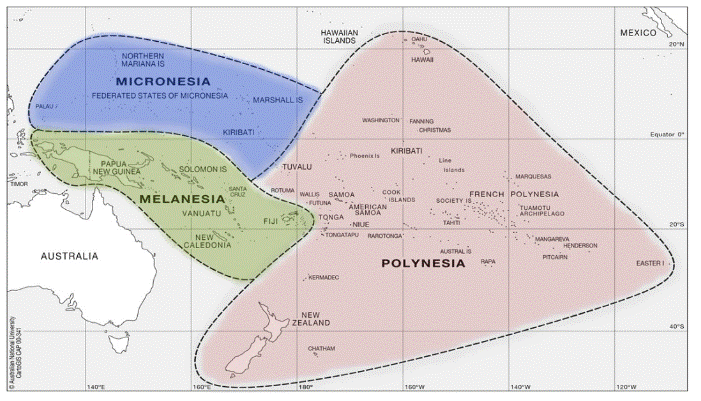
The children will be studying the peoples, cultures and geography within the Polynesian Triangle. These studies can highlight the connections between people and places, including connections to Aotearoa.
The three areas of Polynesia, Melanesia and Micronesia will be studied, and the children can investigate through song, story and culture the differences and similarities of the peoples of the Pacific.
A brief study of the concept of climate zones can lead to investigating the respective specific climactic conditions in the region. This leads to the regional vegetation and resulting agriculture, horticulture and industry.
The geological composition of Australia and the island nations that are studied should be referred to and their mineral makeup noted, also in the context of regional industry.
The Ring of Fire can be investigated and some of the many stories of the volcanic life told. Plotting the area of earthquakes and volcanic activity on a map of the world will demonstrate the activity of the area. This may then be referred back to when the children study the geology of Aotearoa New Zealand.
Our closest neighbour Australia should also be studied. with references to some of the Dreamtime stories of the Aboriginal peoples and Torres Streets Island people. The children can learn about some of the indigenous peoples’ common cultural and artistic aspects. .
Agriculture, industry and natural resources and their use can be studied, perhaps in comparison with similar aspects in Aotearoa New Zealand.
Map making is undertaken, from pictorial representation to accurate reproduction of the land showing major cities, important geological features and areas of economic interest.
Wherever possible people of Australia, and the islands and nations of the Pacific should be invited into the classroom. and where possible important artefacts could be seen and experienced. These guests may be asked to share their memories of growing up in their native region, and stories of their lives may be told with emphasis on the cultural and spiritual values of their people.
Much of this lesson can be structured as an inquiry. Ideally the children can research widely, beyond books, and include sensory (e.g., food, sounds) and artistic impressions in their presentation.
Waldorf Achievement Objectives
Soul and Emotional Development: The children will be led towards
-
Seeking understanding of different peoples with openness and curiosity
-
An appreciation of the differences between peoples
-
A sense for causal relationships between geology, climate and the way of life
-
A sense of identity within the greater Pacific region
Within the expected range of Class 6, the children will be able to:
-
Locate important geological features on a world map
-
Locate the main island nations on a map
-
Draw accurate maps and locate capital cities, states and territories
-
Present a study of a Pacific nation: e.g. geography (including a drawn map), history, cultural and economic overview

Class
7
Statement of Intent
Continuing to strengthen their sense of connection to humanity and human endeavour in space and time supports the unfolding of the children’s individuality. Their expanding relationship with the world is mirrored in the dynamic spatial expansion of the various peoples and navigators; their desire to be in charge of their own affairs is balanced by the growing realisation that first they must learn everything they need to do so.
At a time of inner soul-spiritual upheaval. they turn their gaze outwards and back in time to a period with a similar quality, which saw expansion in thinking and awareness, and unprecedented transformation of world views and values. As the children sense their individuality in its future expression, these historic experiences resonate and support them in their soul wish to begin to take hold of their world and shape it.
Forming a conceptual connection with He Whakaputanga, the Declaration of Independence, and Te Tiriti o Waitangi, grounds the children in the history of Aotearoa New Zealand, strengthening their sense of identity and belonging and grounding them in the preset.
The Class 7 students' experience of the duality between inward focus and outward expansion can be addressed by the geography lessons
Toitu tē whēnua, whatungarongaro tē tangata.
Land is permanent, while people come and go.
Lesson
Te Tuūakitanga o Te Tangata Whenua me te Tangata Tiriti- the meeting of the people of the land and the people of the treaty.
Waitangi Day at the beginning of the school year gives the context for a study of He Whakaputanga o te Rangatiratanga o Nu Tireni – The Declaration of Independence, and Te Tiriti o Waitangi. The class can inquire into the developments leading to the creation of these respective documents, the people involved and the circumstances around their signing – the “why”, the “who” and the “what”. Critical evaluation of respective intent and enacted reality can be expected of the Class 7 children. The origins of the Kingitanga movement can be studied in this context.
Migration and colonization as the origin of these developments are then further investigated in the following Main Lessons. In this way the children gain a relevant and expanded understanding of the causal relationships that have shaped our present.
The Great Explorers
The feats of the Polynesian navigators are a suitable point of departure. Where possible the human experience should be described plotting these journeys can give a useful first understanding of the vastness of the Pacific Ocean.
The stories of these navigators as well as the great Chinese fleet of the 15th century, and of the European navigators and explorers can be told to create a rich tapestry of journeys of exploration.
In the context of the European navigators, it is important that the children are introduced to the Doctrine of Discovery which gave momentum and apparent legitimacy to the explorations and subsequent colonisations. While this aspect needs to be presented in a way that is in keeping with the developmental maturity of the children, it is a lens through which we must learn to view these historical events. Colonial and misguided hero narratives must not be perpetuated, but at the same time the seafaring achievements of these people can be presented as part of humanity’s canon of struggles and challenges met and overcome.
It is important that the children can connect to the human element beyond dates and place names; thus, biographies should be the preferred way to present these stories.
Possible Lesson Content
-
Polynesian ocean voyages and Wayfinding. Decoding the stories of Maui
-
Excursions to visiting waka hourua etc. Contemporary Māori seafarers and navigators, e.g. Tā Hec Busby, Hoturoa Barclay-Kerr, Greg Matahi Brightwell etc.
-
Marco Polo, Henry the Navigator (and possibly the causal connection) , Jack Thatcher
-
The voyages of Zheng He and the Chinese fleet
-
Vasco da Gama, Magellan, Christopher Columbus
-
Voyagers and explorers through the ages; possibly as projects. E.g. Edmund Hillary, Jean Batten, Nellie Bly, Laura Dekker, Roald Amundsen, Sir Ernest Shackleton, etc.
The Renaissance
Through biographies, descriptions of inventions and sketches of aspects of commercial and civic developments, individual initiative, the pushing of boundaries and shifting viewpoints regarding the significance of knowledge and enterprise are illustrated.
The flowering of the feudal city of Florence into the philosophical, scientific and artistic centre of the European world under the beneficent gaze of Cosimo de Medici is a suitable focus. The lives and works of the great artists will be studied by the students, especially Da Vinci, Michelangelo and Raphael. Attention is given to 'reading’ the great works of art, analysing the composition, the colour and the meaning. The lives and works of other artists may be studied through student projects and shared with the class via presentations. Following this Main Lesson, art lessons will be used throughout the year to study and practise copying the works of the great masters, with particular attention paid to the development of perspective and the interplay of light and dark.
The Reformation
The later period of the Renaissance leads into the Reformation. With new discoveries in the arts and sciences and the growing decadence of the church, along with the changing consciousness of human beings, events begin to escalate throughout Europe which culminate in a challenge to the established church and give birth to the new Protestant sects of Christianity. The Roman Catholic Church fights back: the Inquisition is reestablished, burning of 'heretics' becomes common place and emigration begins as peoples of different beliefs seek to find a place in the world where they may be safe and worship autonomously. The biographies of Martin Luther and John Knox could be told. Henry VIll 's disagreement with the Pope over his wish to marry Anne Boleyn may be told and the English Reformation studied.
Waldorf Achievement Objectives
Soul and Emotional Development: The children will be led to an experience of
-
A growing sense of identity as a citizen in Aotearoa New Zealand
-
How different perspectives and experiences lead to different narratives
-
The beauty of the art and brilliance of scientific invention that resulted from the searching and learning of individuals
Within the expected range of Class 7, the children will be able to:
-
Describe, in their own words, the factors that lead to the development of He Whakaputanga and Te Tiriti o Waitangi
-
Describe, in their own words, aspects of voyages of exploration
-
Research, and present a comprehensive project
-
Discuss the major changes in art, science, technology, humanities and civic organisation that occurred in the Renaissance
Lesson
Regions of the World
Moving to the global picture, this main lesson allows for the children to be given ample time to undertake research about the diverse peoples and cultures, and their respective ways of life. This main lesson includes all aspects listed under social and emotional development and the expected range of outcomes.
An important aspect of learning here is to refrain from judgement, but rather develop an appreciation of the complexities of cultural differences; every effort must be made to bring about a heart-warmed understanding of another way of living and being.

Waldorf Achievement Objectives
Soul and Emotional Development: The children will be led towards
-
A capacity for cultural sensitivity
-
A sense of their connection to, and place in, a global community
-
A capacity for respect for the natural world in all its manifestations, and a growing sense of kaitiakitanga
Within the expected range of Class 7, the children will be able to:
-
Locate and name the continents
-
Describe major geological features of the continents
-
Construct a map of the world with main topography and country details
-
Investigate and discuss aspects of society and cultural life in different regions, including common religious beliefs
-
Discuss how climate and topography affect the social, cultural and economic life of a given country
-
Research, prepare and present a project on a given country
-
Research and present a relevant myth, origin story or legend