SEANZ OVERVIEW

Stages of Development
Principle: Stages of Development
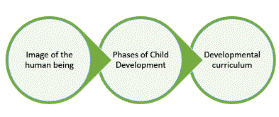
Steiner Waldorf education works with the incarnating process where the spiritual and physical come together to make the whole child. We recognise the physical, spiritual, social and psychological stages, and working with them ensures that we deliver the right programme to learners.
In practice this means
Steiner Waldorf education is an integrated and holistic education. It strives to provide for the rounded and harmonious development of the whole human being, balancing the development of cognitive faculties with the cultivation of social, artistic and imaginative capacities and engagement in practical skills and experiences. The curriculum gives equal attention to supporting the healthy development of the physical, social, emotional, intellectual, moral, cultural and spiritual needs of each child. Although a child might be advanced academically we need to consider all other aspects of their development as well when we are considering their learning programme.
In thinking, clarity;
In feeling, warmth of heart;
In willing, thoughtfulness.
Three overarching seven-year phases in the development of the child are recognised (Steiner, 1998).
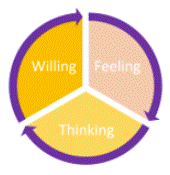
During each phase one of three soul faculties predominates and matures, shaping the way in which the world is met and experienced.
These three soul faculties—thinking, feeling and willing—are all present in different stages of maturation at every point of a child’s development.
Each lesson should recognise the importance of engagement through head, heart and hands and the right balance will be found for each age group.
The forming of the weekly timetable, main lessons and subject lessons should take cognisance of this pedagogical approach.
The first seven years:
Imitation and the development of the will
From birth to seven years of age the children are full of will and movement, living in a world of fantasy and imagination, which they explore through play. They also learn through imitation and a hands-on approach. During these years the life forces of the children are bound up within their physicality,
building and forming a strong healthy body. When this period of bodily development has been completed, at around six-seven years of age, some of the life forces are freed for a different kind of building—the forming of thoughts, at first mostly in the form of inner pictures.
Steiner saw self-directed play as the “work” of the child at this age and as essential for the later development of thinking
(Steiner, 1994).
The heart of childhood:
Imagination and the development of feeling
From seven to fourteen years of age the children begin formal learning when intellectual development is fostered through engaging the feelings. During this “heart” phase of childhood what could be dry, abstract, or disconnected from the child is given life by imbuing it with strong personal meaning.
Learning is largely experiential and the arts become an important vehicle for engagement. Music, dance, storytelling, drama, eurythmy, painting, drawing and modelling provide the means by which concepts, including those of literacy and numeracy, can be brought in a playful, pictorial way. The capacity for creative imagination is cultivated, encouraging thinking that is lively and mobile.
At the time of puberty this capacity for thought becomes more penetrating and reflective as students begin to observe phenomena more closely, grapple with abstract ideas, causal relationships and the rigours of scientific thinking.
Toward adulthood:
Rational judgment and the development of thinking
From fourteen to twenty-one years the adolescent is in transition to adulthood. This period is characterised by intellectual development and the pursuit of worthy ideals. Students are ready for more rigorous self-directed academic learning, which requires clarity, objectivity and independent judgment. The high school curriculum is designed to inspire students to question, reflect, arrive at
theories through the exploration of phenomena, analyse logically and view the world from a range of different perspectives.
In Steiner Waldorf education, readiness to learn is a guiding principle. Up until the developmental threshold of the child’s seventh year, their education takes place in the kindergarten, where learning occurs through play and imitation.
Although it is recognised that children can be taught to do many things before this time of physical and soul readiness, this is seen to come at a cost that will become apparent in later years (House, 2012; Suggate, 2010, 2014). The principle of readiness stands true right through the primary and high school years.
Steiner Waldorf education respects the integrity of childhood and what is seen to belong rightfully to childhood. As a child progresses through school, emphasis is given to his or her individual development in an environment which is non-competitive and unpressurised in the academic sense.
Teachers actively protect and cultivate the young child’s capacity to wonder, to imagine and to experience awe and reverence for life and learning in a manner that is unhurried.
Children learn at their own pace, guided and encouraged by the teacher, who is alert to the particular intelligences that emerge as well as any obstacles to learning that need to be overcome. Allowing children to experience a full and healthy childhood is seen as vital for laying the foundations for a healthy adolescence and well balanced adulthood.
Learning in time,
over time.
"I am struck by the fact that the more slowly trees grow at first, the sounder they are at the core. We do not wish to see children precariously making great strides in their early years like great sprouts, producing a soft and perishable timber, but better if they expand slowly at first and so are solidified and perfected."
Henry David Thoreau (1892, p. 222, entry of November 5, 1860)