SEANZ OVERVIEW
The Twelve Senses
Principle: The Twelve Senses
Steiner Waldorf education aims to develop the entire human being nurturing and developing all twelve senses.
Steiner Waldorf education aims to develop the entire human being nurturing and developing all twelve senses.
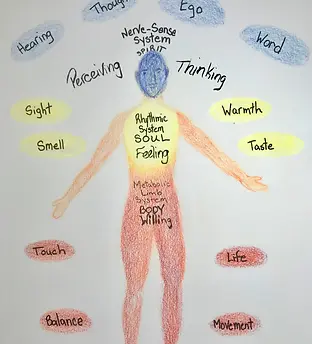
In Steiner education, the concept of the twelve senses is fundamental to understanding the development of the human being. These senses are divided into three groups, each connected to different aspects of human experience:
1. Senses of the Body (Foundational Senses)
These senses help us experience our own body and establish a foundation for other senses:
-
Sense of Life: Awareness of one's physical well-being or discomfort, hunger, thirst, and general vitality.
-
Sense of Movement (Kinesthetic Sense): Awareness of one's own movements, including coordination and balance.
-
Sense of Balance: Awareness of the body's position in space, helping maintain equilibrium.
-
Sense of Touch: Awareness of external contact, helping differentiate between the self and the external world.
2. Senses of the External World (Middle Senses)
These senses help us connect with the external world, forming the basis for social interaction:
-
Sense of Smell: Awareness of scents and odors, providing information about the environment.
-
Sense of Taste: Awareness of flavors, helping discern different substances in the mouth.
-
Sense of Sight: Awareness of light, color, and form, providing a visual perception of the world.
-
Sense of Warmth: Awareness of temperature, particularly the warmth of other beings and objects.
3. Senses of Understanding (Higher Senses)
These senses relate to our ability to understand others and engage with the world on a deeper level:
-
Sense of Hearing: Awareness of sounds, including speech, music, and environmental noises, contributing to communication and rhythm.
-
Sense of Speech (Word Sense): Awareness of the meaning and intent behind spoken words, enabling comprehension of language.
-
Sense of Thought (Concept Sense): Awareness of the thoughts and ideas of others, allowing us to grasp concepts beyond the spoken word.
-
Sense of Ego (I-Sense): Awareness of the individuality and selfhood of others, recognizing them as distinct beings with their own inner life.

These twelve senses are seen as pathways through which a child experiences and interacts with the world. Steiner education aims to nurture these senses holistically, ensuring balanced development. For example, a focus on movement and rhythm in early childhood helps establish a strong foundation for cognitive skills that emerge later. Similarly, artistic activities engage the middle senses, while higher senses are developed through storytelling, conversation, and social interaction.
By fostering all twelve senses, Steiner education seeks to cultivate well-rounded individuals who are physically, emotionally, and intellectually balanced.
In practice this means:
In Steiner schools, the day usually starts with a handshake between the teacher and each student and this is a symbolic and intentional practice. It serves several important purposes:
-
Personal Connection: The handshake establishes a personal connection between the teacher and each student, acknowledging them as individuals. It creates a moment of direct, one-on-one interaction that fosters a sense of being seen and valued.
-
Transition and Grounding: The handshake marks the transition from the home environment to the school environment. It helps ground the student, signaling the start of the school day and the beginning of focused learning.
-
Mutual Respect: This gesture is a mutual exchange of respect. It teaches students the importance of greeting others in a respectful and mindful way, reinforcing social etiquette and the value of human interaction.
-
Observation and Care: The handshake provides an opportunity for the teacher to observe each student closely. By feeling the student’s hand and observing their demeanor, the teacher can gain insights into how the student is feeling—whether they are anxious, tired, or full of energy—allowing for a more tailored approach to their needs that day.
-
Sense of Belonging: For students, the daily handshake reinforces their place in the classroom community. It reassures them that they are an integral part of the group and sets a positive tone for collaborative learning.
The beginning of the day is then grounded in a daily rhythm - the lighting of a candle, the reciting of a verse and then moving into voice, movement and musical activities leading into the Main Lesson.
Rhythm is fundamental to the health of the human being. The quality of each day, the progression of each week, the passing of the seasons, the annual signposts of celebrations and festivals all work to create a healthy rhythm in school life. Teachers use rhythmic processes to structure their teaching within the daily, weekly and main lesson timetable in ways that harmonise with the physiological needs and learning processes of the children.
In every lesson the teacher strives to provide structure and rhythm by creating times of “breathing in” and “breathing out.” This might come through finding a healthy balance between the poles of concentration and relaxation, focussed intellectual activity and practical or artistic activity, movement and rest, group and individual work. Generally the morning is better suited to learning that requires mental wakefulness and the afternoon to practical and artistic
activity.
Learning with a Rhythm
Learning through the Arts
Learning through Rich Integration
Main Lessons are an established part of a Steiner curriculum. The placement of each main lesson in the set of main lessons from Class 1 through to Class 12 is deliberately placed to serve the developmental age and stage of the students at that class level.
Many main lessons build on main lessons from previous years.
The placement of main lessons progress in a way to support the unfolding consciousness of the students from Class 1 through to Class 12, from doing to feeling to thinking.
Each main lesson feeds another main lesson, and they are interconnected across the 12 years, so any changes need to be considered as a united whole, not just within the context of each subject.
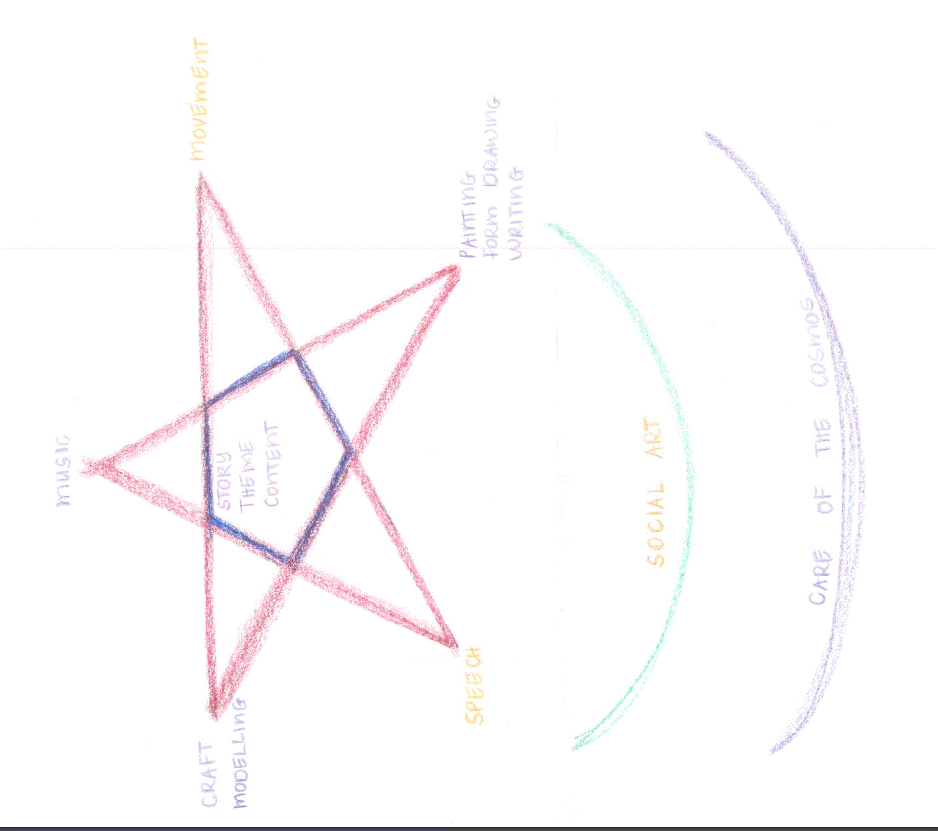
The purpose of a main lesson is to open a window into the world of a topic or subject while further developing the students’ skills of thinking as well as the appropriate technical skills (literacy, mathematical concepts, scientific conventions). The aim is to bring content through a range of modes, including movement, singing, storytelling, art, poetry or music. The learning rhythm is consciously developed, delivered and led by the teacher. A learning rhythm encompasses
-
recall and reflect on prior knowledge (develop/responding to context)
-
present and discuss new learning (modelling and guided)
-
explore and consolidate the learning (guided independent)
Main lessons run for a block of time every day for approximately three weeks. Each main lesson should have a rhythm of engaging the feeling realm followed by the thinking aspects, incorporating movement or opportunities to ‘do’ as needed. This rhythm might be true over the course of the three weeks but will also be evident in the daily session in the main lesson.
Educators need to consider how they will bring this topic to students in a way that the students will connect with it and form a relationship with the material in order to open a curiosity and engage with it. Educators should consider each Main Lesson they approach firstly from what they already know of the students in front of them and how best to bring this main lesson to them. In every main lesson, no matter how many times it has been repeated an educator should be stretching themselves to bring something new to the main lesson.
There may be learning outcomes for qualifications attached to the main lesson.
There are also Education Outside the Classroom components of several main lessons.
Students create their own book based on what they learn in class. Main lesson books might contain art responses, written responses, final compositions in relation to the topic of the main lesson. By the end of the main lesson the main lesson book should have a record of everything they studied and felt and learnt through this Main lesson.
Main lessons should align to the impulse themes, key capacities and pedagogical aims
The Importance of Arts, Handwork and the Practical Curriculum
Every child will learn to sing, play musical instruments, paint and draw, sculpt, move with grace and awareness, write, learn and recite poetry, act in plays, knit and sew, work with wood and metal, model wax and clay and create work that is beautiful as well as useful. In addition, opportunities for gardening and cooking are woven throughout the curriculum, from kindergarten through to high school.
The Outdoor Classroom is a feature of the curriculum in many Steiner Waldorf schools where a range of traditional handcrafting processes are experienced in the natural environment (e.g. constructing treadle lathes or harakeke)
For it is of very great importance that you not only make all your teaching artistic, but that you also begin teaching the more specifically artistic subjects—painting, modelling, and music, as soon as the children come to school, and that you see to it that the children really come to possess all these things as an inward treasure.
(Steiner, 1995, p. 99)
Education outside the classroom has a significant role in learning programmes. For example, a local history and geography main lesson in Class 4 will have children out and about exploring their wider community; a trigonometry lesson in Class 10 might have students on a “trig camp” learning surveying techniques.
Camps are a highlight of each year and give important opportunities for immersion in practical learning (e.g. bushcraft, orienteering) as well as providing thresholds or rites of passage that challenge students to take new steps.
Education Outside the Classroom
A Rich Oral Culture
In Steiner Waldorf schools the fundamental elements of emerging literacy are nurtured in the Kindergarten, where children, active in imaginative play, live in an environment steeped in oral tradition, in rhythm, story, conversation and song. When the child enters school, this conscious focus on oral language remains central to many areas of learning. The power of narrative and verse is seen to have profound significance in Steiner Waldorf pedagogy. In the early years most learning is brought in narrative form. Whatever the subject matter, if it is brought through a well-crafted story (e.g. imaginative or biographical), the children will identify and engage with it and experience that it has
relevance for them.
Children hear stories from many sources such as fairy and folk tales, legends, fables, parables, mythology, history, biography, literature and in a variety of forms, such as prose, poetry, song and drama. The emphasis is on the teachers telling the stories in their own words, crafting them to meet the needs and temperaments of the children. Storytelling is also used as a tool for healing and to help children find ways to deal with life difficulties and challenges. Teachers will often create their own stories to meet specific situations as well as drawing on quality literature to read to the children.
Students actively participate in this oral tradition with the retelling of main lesson stories, through the recitation of learned poetry or, for example, through puppetry and plays.
As students progress through the middle school and into high school, they are increasingly encouraged to engage in debate, dialogue and exchange of ideas. Subjects are brought to life through the biographies of people who have been pioneers, leaders, or central figures in a particular field. Student project work is often accompanied by a verbal presentation. The Class 12 project presentations, delivered to a large community gathering, is a feature of all New Zealand Steiner Waldorf high schools.